

The Role of AI in RF Signal Classification for Counter-Drone Detection
Airports and aviation facilities employ drone detection systems which typically combine RF sensing, radar, and electro-optical or infrared confirmation, to identify unauthorized drone activity near runways and approach paths. Detection alone doesn’t stop a drone, but it does give air traffic and security teams the information required to decide whether to delay operations, alert authorities, or initiate an approved mitigation response.
Drone sightings near airports are no longer isolated incidents. The volume of drone sightings at airports are increasing year on year. The FAA alone receives more than 100 reports of drone sightings near airports every month, with airports around the globe certainly not immune.
Each incident initiates a chain of events and decisions that can ground aircraft, divert flights, cause delays, and result in thousands of passenger trips being affected. In more drastic circumstances, public safety can be compromised.
The question isn’t whether drone detection airports require a dedicated counter-drone solution. The question is what kind of detection architecture is required to make that subsequent decision sequence faster, more accurate, and more defensible.

How Does AI Classify RF Signals from Drones?
When an RF sensor detects a signal, the data it captures includes its frequency, the way it's modulated, and how the modulation pattern changes over time. These characteristics collectively form a signal signature. Different drone platforms (and their respective telemetry, drone control links, and video feeds) produce unique signatures that can be matched to a specific UAS.
Legacy AI drone signal classification works by comparing the detected signal's characteristics against a reference catalog of known drone signatures. The comparison involves modulation analysis, waveform matching, and frequency behavior assessment, performed by a machine learning drone detection model trained on thousands of real-world signal captures from known platforms under varied conditions.
When a new signal is encountered in the field, the model identifies which known signature it most closely resembles and assigns a “confidence score” to that signature match. If the confidence score is high enough, the CUAS solution classifies it as a drone detection.
In theory, this sounds simple, but in reality, this process is exceptionally complex and requires world class engineering and operational knowledge. RF signal classification technology operating at this level of specificity, amid a maelstrom of competing RF traffic, requires more than basic pattern matching.
The complexities include processing signals that typically degrade over distance, reflect off surfaces, and vary significantly with environmental conditions and urban clutter.
With such intricacies complicating straight signal matches, the detection engine has to generalize from its training data to identify signals (as correctly as possible) that it may not have encountered before, in environments it hasn't been trained in. The veracity of that generalization is the real difficulty and it's what separates high-performing drone classification systems from those that perform well in test environments but falter in the real world.
How a System Is Trained to Recognize Drone Signatures
Training a traditional detection engine begins with signal capture. Engineers capture RF emissions from known drone platforms across a range of operating conditions. This needs to be done in both pristine environments and real-world scenarios, and must include testing for different distances, environments, flight modes, and control link configurations.
All of those captures are then labeled by platform type and used to train the classification model. The model learns to associate specific signal characteristics with corresponding drone types, and to distinguish those characteristics from the signal profiles of non-drone devices.
The signal signature library underpinning this process isn’t static. New drone platforms enter the market continuously, and adversarial operators modify existing platforms to avoid detection. This is an extremely significant issue.
A classification system that isn't continuously updated as the threat environment evolves will degrade in coverage and mission-effectiveness over time, even if its core algorithm remains sound. Continuous catalog updates are as important as the initial training, and the robustness and currency of a vendor's signal capture program is a key factor in drone detection performance.
What Happens When a Drone Is Not in the Catalog?
A new approach is required. The central problem with catalog base drone detection is that there are countless drones out there that haven’t been logged.
Most detection engines and thus RF counter-drone solutions can only see what they’ve been trained on. An unknown drone will simply fail to trigger an alert, as it hasn’t yet been captured, labeled, and added to the training dataset. Under a pure signature-matching architecture, that drone is essentially invisible.
As drone production around the world accelerates, the number of novel, modified, and purpose-built platforms is climbing sharply. That ubiquity in turn becomes a real-world airspace vulnerability rather than a theoretical limitation for catalog-based detection.
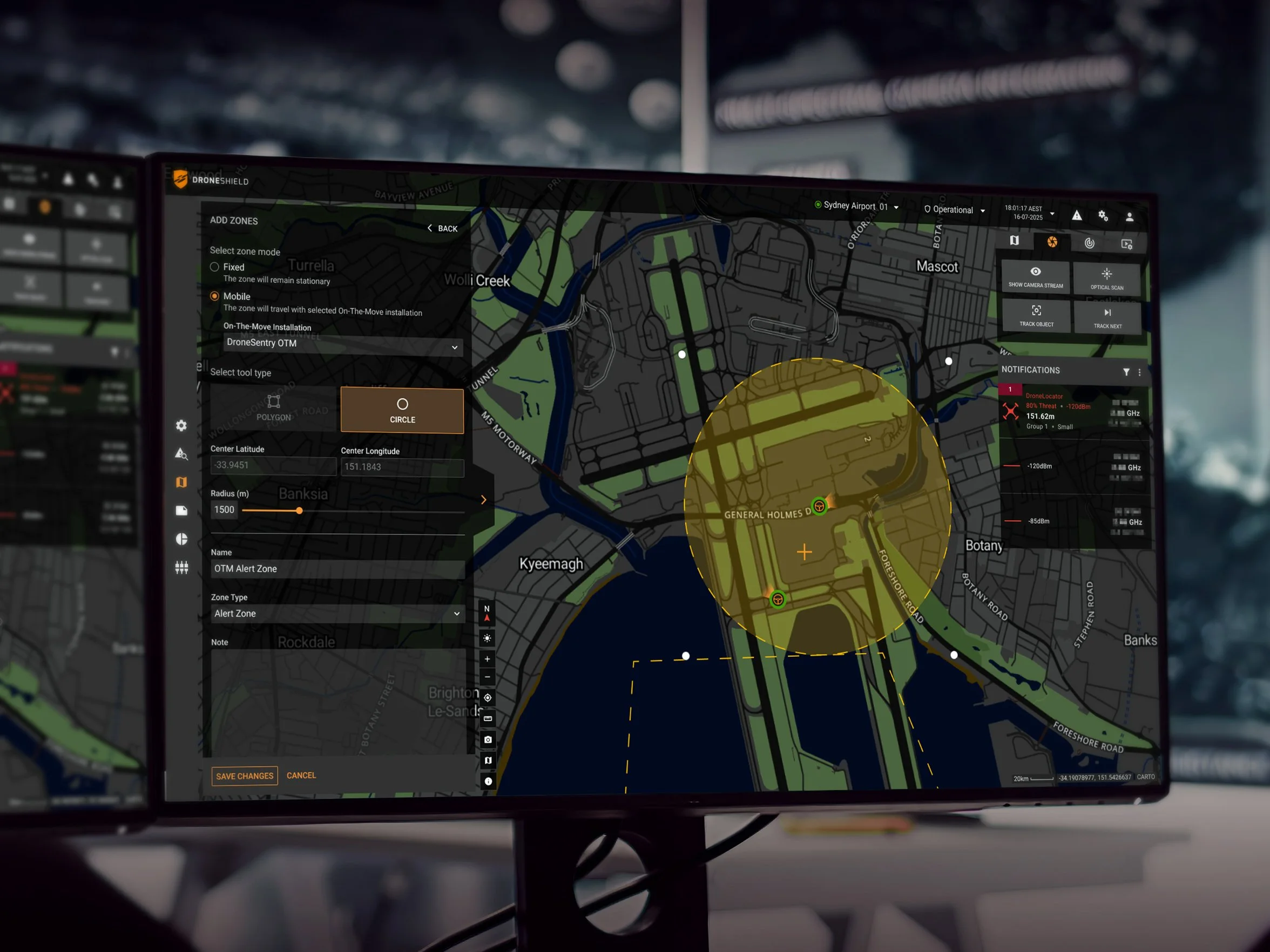
Next-generation AI detection engines like DroneShield’s RfAI-3 address this by detecting drones never encountered or recorded before.
The RfAI-3 model deploys intelligent signal characterization that analyzes detected RF signals not only for catalog matches but for anomalies characteristic of UAS operation, regardless of whether that specific platform has ever been encountered before or not. This approach breaks the traditional catalog-based detection doctrine.
Rather than asking whether there’s a known signal match, the next-gen model asks whether the signal exhibits behaviors, modulation patterns, frequency characteristics, and movement properties, consistent with drone operation. The principle behind this approach is that a drone that’s never been cataloged anywhere still produces a signal that behaves like a drone.
This advancement matters most in situations where adversaries are actively engineering to evade catalog-based detection by using DIY platforms, modified commercial drones on non-standard protocols, or frequency-hopping control links. Not to mention non-adversarial drone pilots that are simply running new, as-yet-uncaptured drone models.
Why Classification Matters More as the RF Environment Gets Noisier
In dense urban environments, where thousands of devices are generating concurrent RF activity, drone detection becomes significantly harder.
The various links between a drone and its operator sit against a background of thousands of Wi-Fi, cellular, Bluetooth, and IoT emissions, many of which share frequency bands with common drone protocols. Without effective classification, every signal looks like a potential threat. This means that to combat the RF “noise floor”, a detection engine needs to be able to filter out non-drone signals before they reach the operator.
In signal dense environments, avoiding false positives is a significant challenge and needs to be accounted for, lest every unknown signal sets off an alarm. A sophisticated CUAS solution should only alert an operator with signal-matches of significant confidence, worthy of awareness and response.
This is also where autonomous classification counter-UAS capability becomes invaluable. In a high-tempo environment, the sheer volume of signal activity makes human review of raw classification data at best impractical and at worst virtually impossible. Classification automation is required to process the signal traffic, filter non-drone activity, and surface confirmed or high-confidence drone detections. The operator then receives a full threat picture rather than raw data.
As a real-world example, at the 2026 FIFA World Cup in Kansas City, DroneShield's detection architecture supported a multi-agency security operation covering one of the highest-profile public events in the US. The RF classification layer was central to managing detection across a dense urban environment where signal volume was high and the consequences of false positives, unnecessary disruptions to an event attended by tens of thousands, were significant.
Where Automation Helps, and Where Human Review Still Matters
Autonomous classification in counter-UAS means that the system performs signal identification and drone confirmation without relying on manual signal data review for every detection event.
Human review, however, still remains essential at the response stage. While solid classification tells the operator there’s a potential drone signal, the decision process from there around response and authority escalation involves legal, regulatory, and situational factors that classification alone can't resolve. Counter-UAS systems that automate response without human authorization in the loop carry significant legal and operational risk in most jurisdictions.
The practical architecture in most serious deployments is a tiered model. Autonomous classification:
Filters and confirms detections
Surfaces a threat picture to the operator with confidence scores and classification data
Cues the operator to decide on response based on the information at hand
The machine learning model does the processing work. The human does the judgment work.

Frequently Asked Questions About AI Signal Classification
Q: How does AI classify drone signals?
A: Traditional AI systems analyze characteristics of a detected RF signal, such as modulation pattern and frequency behavior, and compare them against a trained reference catalog to identify whether the signal is a drone and often its specific make and model. Next-gen detection engines can now characterize a drone signal without relying on a catalog at all.
Q: Can AI tell the difference between a drone and a Wi-Fi signal?
A: Yes. Classification systems are trained to distinguish drone RF signatures from other common signal types, including Wi-Fi, Bluetooth, and cellular activity. This distinction is essential in real-world RF environments where non-drone signals significantly outnumber drone signals.
Q: Does AI drone classification replace human decision-making?
A: No. AI classification speeds up identification and reduces the signal volume operators need to review, but response decisions in most deployments still involve human authorization, particularly in legally or operationally sensitive situations.
Drone Classification in Real-World Deployments
The gap between AI counter-drone detection that performs in controlled testing and systems that perform in real operational environments is determined by training data breadth, catalog maintenance, and how the system handles signal conditions it hasn't seen before. Those variables are worth evaluating before a system is specified.
Teams assessing RF classification capability and counter-UAS detection architecture can request mission-specific support from the DroneShield team: https://www.droneshield.com/connect-with-us