

The global commercial drone market was valued at USD 24.4 billion in 2025 and is projected to grow to USD 52.1 billion by 2033, with new models hitting the market at a rapid rate. That’s not to mention the near-incalculable proliferation of novel DIY platforms.
The pervasive issue with radio frequency (RF) detection is that the current doctrine is built on cataloging the emissions of new drones, but this approach has a hard ceiling. RfAI-3 removes it.
The Limits of Signature-Based Detection
Every traditional RF detection system deployed today operates on the same logic:
A drone emits a signal
That signal gets matched against a database of known RF signatures
If there's a match, the drone is detected
If there isn't, the drone is invisible
Legacy RF detection requires a drone to be classified before it can be identified. As savvy adversaries continue to create novel, commercially sourced, and purpose-built UAS on frequencies and protocols outside of known and cataloged parameters, that creates a detection gap. A gap that’s being actively exploited by adversarial actors.
When a new emitter is first encountered by a sensor, there's typically no confirmed warning of an anomalous drone. The detection engine simply doesn't know what it doesn't know.
The answer to this elusive and central problem is RfAI, DroneShield's AI-powered radio frequency detection engine, designed for real-time drone detection and classification.
Three generations of RfAI have now been engineered, each extending the scope of airspace intelligence collection. RfAI-3, the third generation, doesn't just go further. It breaks the model entirely.
The First Generation Proved the Model
The original RfAI successfully established that advanced AI-powered RF analysis could detect drones in environments where precision rule-based systems couldn't.
RfAI built DroneShield's RF intelligence dataset from the ground up, proving that real-time detection of known drone emitters was achievable amid signal-cluttered, physically anomalous, and contested RF environments, and that machine learning applied to spectrum analysis could classify emitters with a degree of accuracy that legacy approaches couldn't match.
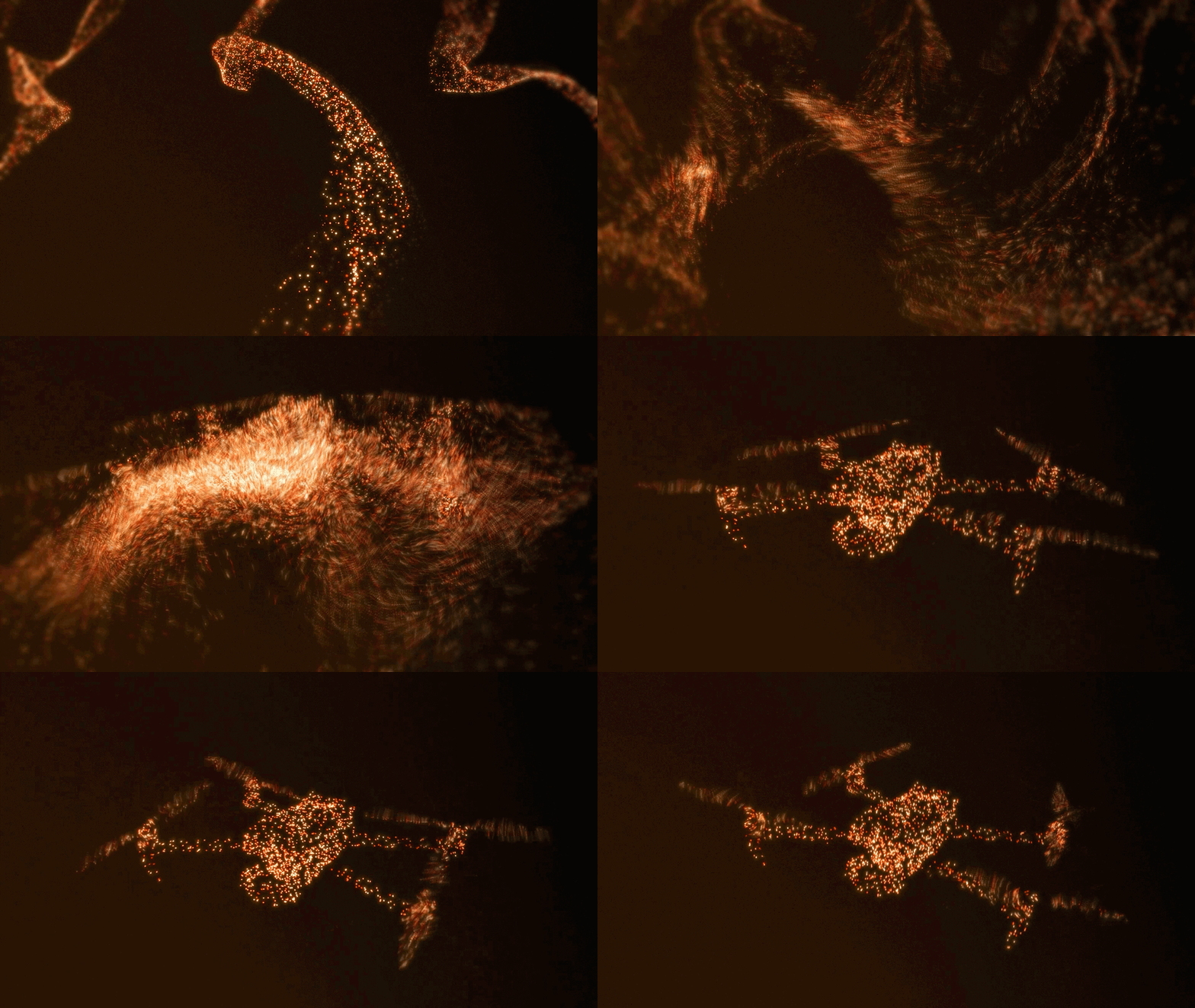
What this formative technology delivered was foundational: AI-powered RF detection, known emitter classification, real-time processing, and the first version of an RF dataset that would compound in value across every subsequent generation.
The detection engine limitation, however, was architectural in nature. Detection required a drone to already exist in the catalog, meaning what it hadn't seen, it couldn't find.
The Second Generation Brought the Dataset to Life
RfAI-2 didn't just improve detection accuracy, it transformed the nature of the dataset.
Where the first generation built the catalog as a fixed asset, RfAI-2 made it a living system. Every deployment contributed to global classification strength. Each new drone encountered in the field, each new protocol identified, each new threat vector captured was added to the dataset and distributed across every deployed unit. Accuracy improved as false positive rates dropped. Field hardening through operational exposure also began to compound with scale.
RfAI-2 is the platform that earned DroneShield CUAS operator trust globally. The evolution brought multi-protocol detection, continuously expanding threat models, and stronger classification accuracy. The intelligence grew with every engagement, and the dataset behind it became an ever-improving asset. It was also able to flag unusual RF behavior despite a lack of logged and confirmed UAS data.
But the detection paradigm hadn't changed at its core. The signature-match model was stronger, faster, and more accurate than the previous generation, yet it still relied heavily on a drone being characterized and cataloged before a detection could be confirmed.
The primary data gap remained, and it was widening as drone production rose, coupled with the proliferation of DIY drones and a wide range of operating signatures and behaviors. Adversaries, of course, understood this structural exploit and began engineering toward it.
RfAI-3 Breaks the Paradigm Entirely
Where every previous generation was reliant on a drone being cataloged before it could be identified, RfAI-3 detects drones that have never been seen or classified before.
RfAI-3 doesn't simply search a fixed dataset for a match. It uses an advanced AI model to analyze RF signatures for anomalies characteristic of novel UAS operation, regardless of whether that emitter has ever been encountered anywhere.
Operating across the full supported RF spectrum up to 7.1GHz, this third-generation detection engine delivers continuous, real-time ultra-wideband monitoring of the electromagnetic environment, detecting and classifying all RF emitters within its coverage area, including Wi-Fi, cellular, and purpose-built drone protocols. The RfAI-3 model identifies and prioritizes detections automatically, simplifying the operator experience and reducing time to action.
This isn't an incremental upgrade of RfAI-2, it's a doctrine shift.
The RfAI Generational Arc
| RfAI: The Foundation |
RfAI-2: The Living Intelligence |
RfAI-3: The Breakthrough |
|
|---|---|---|---|
| Detection Model | Signature match against known emitters | Signature match, expanded continuously | AI-powered detection without reliance on signal matching |
| Unknown Emitters | Invisible | Invisible | Detected |
| Dataset | Static build | Living, expanding with each update | Introduces detection beyond the dataset |
| Adversary Evasion | Exploitable gap | Exploitable gap | No exploitable gap |
| Novel Drone Detection | Not possible | Not possible | Possible |
| Frequency Coverage | Narrow-band | Multi-protocol, expanding | Full ultra-wideband to 7.2GHz |
Signature Matching Alone Can Be Exploited
The signature-match detection methodology is structurally rigid, no matter how well the catalog behind it evolves.
Novel platforms exist outside of established datasets by definition, and that gap can't be fully closed by simply adding signatures faster. DIY and purpose-built adversarial drones are increasingly engineered to operate specifically on frequencies and protocols that classification-based indexes haven't seen.
For example, many modern drone control links increasingly ‘frequency hop’ across the RF spectrum to remain connected. This mechanism of jumping between frequency bands can increase link reliability in everyday commercial drones, or be used for deliberate evasion by adversarial engineers. The result in either case is the same: a signal that resists clean matching.
Spreading a signal across a wide, fast-changing range makes clean signature matching far more difficult, complicated further when combined with saturated electromagnetic environments where hopping patterns collide with Wi-Fi, Bluetooth, and other RF traffic.
Ukraine has made the limits of catalog-dependent detection unmissable. It’s the most complex RF environment in active global use, producing novel drone platforms continuously under real combat pressure.
In the first half of 2026 alone, Ukraine’s Defense Ministry codified 413 new unmanned aerial systems, up 73% percent from the same period in 2024. That’s more than two novel drones per day, almost exclusively home-made DIY models never seen before, let alone cataloged. This gives insight into what’s occurring right now on a global scale.
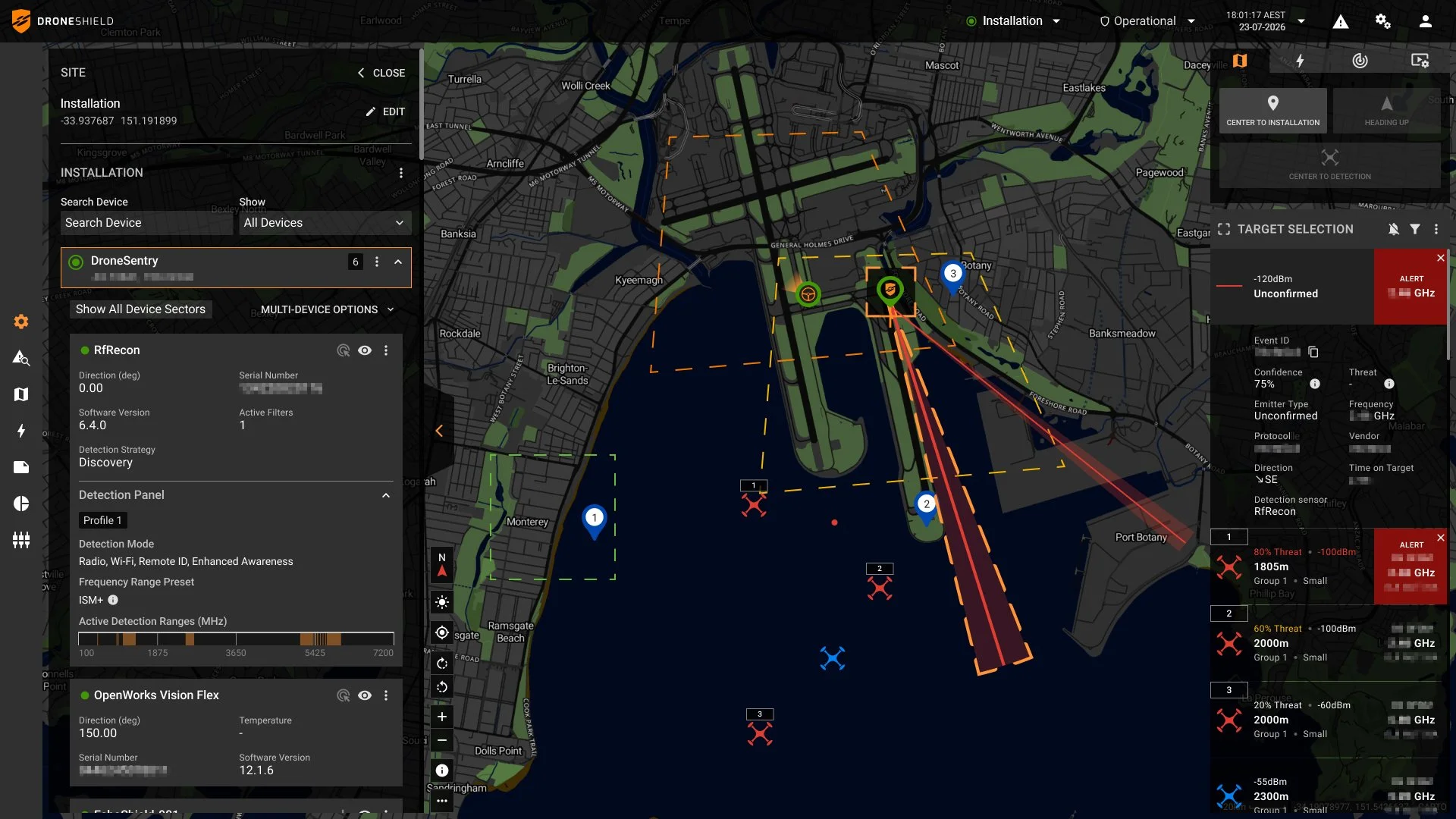
Image: RfAI-3 senses unknown RF emissions within DroneSentry-C2 for operational context and rapid decision-making.
The Battlefield Advantage
The RfAI-3 detection engine identifies RF anomalies characteristic of UAS operation across the full spectrum, from power-on through terminal approach, regardless of whether the platform is hopping frequencies, running an uncataloged protocol, or is a new DIY FPV.
The ability to stay ahead of drone innovations in the field and identify and flag platforms never before encountered, ensures operators have the best airspace intelligence available, staying ahead of evolving UAS threats.
Combined with radar and EO/IR in a layered CUAS architecture, next-gen RF detection provides the earliest actionable indicator available.
RF Remains the Core of Modern CUAS Military Architecture
It's worth addressing an oft-stated claim in modern defense and CUAS discourse: that RF detection is becoming obsolete due to the emergence of fiber-optic controlled FPV drones. There's no doubt that fiber-optic FPVs pose a genuine challenge, as seen with their growth in Ukraine, specifically because they resist RF jamming and RF-based control link detection. But they're range-limited by the physical cable, account for a fraction of the overall threat picture, and aren't representative of the vast majority of UAS platforms that operate on RF.
RF is far from dead. It remains the foundational detection tier in any serious, layered CUAS architecture, with ultra-wideband AI detection extending the operational effectiveness of that layer further than any previous generation.
The Civilian Airspace Advantage
Commercial drone proliferation is increasing the security risks at airports, utilities, energy facilities, ports, and public venues faster than detection methodologies can adapt.
New drones are appearing in sensitive airspace before tracking systems can classify them, causing intelligence blind spots that expand with every production cycle.
For civilian security teams, the consequence of an undetected drone is not just a tactical issue. It means an airspace shutdown, a severe safety failure, a liability event, and a public record of a preventable security lapse.
Security teams can’t respond to threats they can’t see. With RfAI-3, uncataloged platforms can now be identified and flagged from the very first signal, not after the fact when the consequences have already been realized.
The Window Is Closing
Three conditions are converging that make detection architecture decisions a matter of urgency.
Drone proliferation is accelerating
Commercial and DIY production is climbing every year, and the proportion of new platforms appearing in threat environments before classification grows with it. The catalog gap widens every quarter.
Adversaries are engineering to evade
The structural gap in signature-based detection is no longer theoretical. Adversary systems are being actively built to operate within it.
The electromagnetic environment is saturating
Active conflict zones and dense civilian airspace are increasingly crowded with RF signals, and narrow-band matching degrades exactly where detection matters most.
The organizations that deploy AI-powered wideband detection capability first will have a structural detection advantage over those that don't. Every quarter of delay is a quarter of exposure.
Legacy Systems Know Yesterday's Threats. RfAI-3 Detects Tomorrow's.
RfAI-3 is the product of three generations of development, field hardening, and dataset expansion applied to a detection architecture that no longer has a ceiling defined by what's already been cataloged.
The RF intelligence dataset isn't a static index, it's a continuously expanding intelligence asset. Every new drone model encountered improves detection accuracy for related and adjacent threat signatures.
RfAI-3 means emerging drone threats are identified before they can establish a deployment advantage.
Talk to the DroneShield team about RfAI-3 and specific mission parameters.