

Why Ultra-Wideband Capability Is Vital for Countering Evasive Drones
The drones being fielded in 2026 are not only increasingly sophisticated in terms of flight capabilities and payload capacities, they're also more agile in the way they communicate across the RF spectrum.
Modern adversaries are specifically building DIY platforms to frequency hop and operate in the gaps between commonly scanned frequencies to avoid detection.
This kind of RF adaptation leaves narrowband counter-drone detectors at risk of missing active drones entirely and overlooking vital airspace intelligence. This is why ultra-wideband scanning needs to be a baseline capability for modern counter-drone operations.
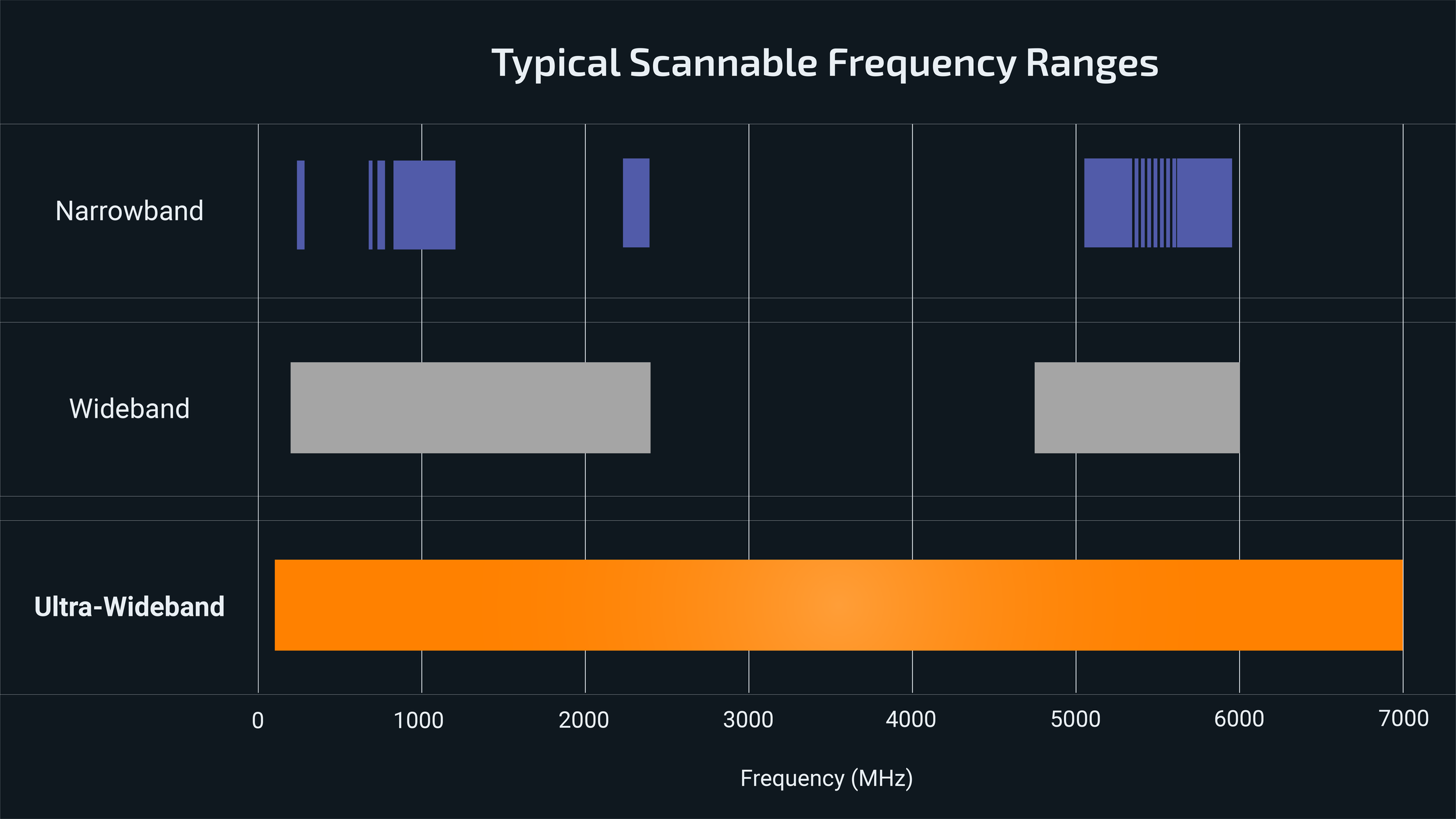
Typical and indicative scanning ranges by device type. When detecting evasive drones, there’s a meaningful difference between narrowband and ultra-wideband capability.
What Is the Difference Between Narrowband, Wideband, and Ultra-Wideband?
The difference between narrowband and ultra-wideband RF detection is stark. This is not merely a capability difference on paper, but a sizeable gulf in fielded effectiveness. In the real world, it can come down to a drone being detected, or not.
What Is Narrowband?
Narrowband RF detection systems monitor a defined, limited set of frequency ranges, typically the common control link bands used by commercial drone platforms such as 2.4 GHz and 5.8 GHz.
Such RF detectors were designed for a threat environment where drones operated predictably on well-known frequencies. Traditionally, narrowband monitoring was sufficient. That environment no longer exists.
A narrowband drone sensor will detect the majority of off-the-shelf consumer platforms operating as designed but will miss any platform operating outside those bands. Savvy adversaries know exactly where those gaps are and will move to exploit them.
What Is Wideband?
Wideband RF detection covers a broader frequency range than narrowband systems and represents a genuine improvement in coverage. Many CUAS solutions in operation are accurately described as wideband and can cover a very meaningful slice of the spectrum.
However, wideband is not a standardized specification, and the term is applied across systems with vastly different coverage ranges. Many wideband systems cover, for instance, between 1 and 2 GHz of the RF spectrum, though this varies significantly. For an organisation evaluating a solution’s drone detection capability, the specific frequency range covered matters more than the label.
What Is Ultra-Wideband?
True ultra-wideband RF detection rapidly monitors an extremely broad frequency range using an advanced algorithm to decide where to focus. DroneShield’s RfRecon for example, monitors across a 7.1 GHz frequency range continuously, compared to narrowband systems that cover a fraction of that.
The operational consequences are significant. A drone operating outside the monitored bands of a narrowband or wideband system generates no alert. It won’t appear on any TAK or Command and Control screen and is functionally invisible.
Ultra-wideband coverage has the advantage of sensing a broad and unbroken swathe of the spectrum, uncovering evasive drones attempting to hide activity in uncommon frequencies.

Drones are routinely being engineered to evade detection.
Adversaries Will Always Exploit Holes in Narrowband Counter-Drone Coverage
Canny adversaries, whether on the battlefield or targeting critical infrastructure, will attempt to discover the type of CUAS solutions being fielded.
Once an assumption or confirmation of RF coverage has been made, they can deploy drones with specific characteristics to exploit those holes and avoid detection.
If a nefarious actor discovers that narrowband or limited wideband scanning technologies are being deployed, or identifies specific frequencies being scanned, they will design and configure their platforms to operate outside of those bands. This kind of exploitation is made simpler by harnessing software-defined radio (SDR) and frequency-hopping protocols.
The mind of the adversary is straightforward: find out what bands are being scanned and operate between them. Further obfuscation and jamming resistance is possible with custom frequency hopping.
The Problem with Frequency-Hopping Drones and Software-Defined Radios
Two capabilities in particular have made evading detection significantly easier: frequency hopping and software-defined radio. Understanding both is essential to understanding why ultra-wideband detection is a baseline requirement.
Frequency-Hopping Platforms Can be Designed to Evade
Frequency hopping is the rapid switching of transmission frequencies to maintain a stable link, avoid interference, evade detection, or resist electronic jamming.
In potentially benign cases, common platforms from well-known manufacturers like DJI, Autel, and Skydio use FHSS (Frequency Hopping Spread Spectrum) to cut through RF noise and provide stable connections for end users. These proprietary protocols are well characterized by the counter-drone detection community.
The threat picture shifts when those with more sophistication build their own platforms. Custom DIY drones can be engineered with non-standard hop protocols or wideband agility specifically to confuse common sensors and defeat standard electronic warfare countermeasures.
A narrowband system monitoring fixed frequencies will only sense such transmissions when the hopping sequence happens to land within its coverage range, which may be rarely, briefly, or not at all. The result is, at best, intermittent detection.
Software-Defined Radio Allows Frequency Manipulation
SDR compounds the detection challenge further, allowing adversaries to simply shift frequencies to take advantage of known gaps in coverage and evade RF detection.
Traditional radio hardware operates on fixed frequencies which are determined by physical components. SDR uses software to define operating parameters, allowing for customized frequency changes.
This means an adversary can reconfigure the frequency, modulation, and protocol of a drone platform quickly, easily, and without necessarily having to modify any hardware. A given platform that was operating on a specific frequency yesterday can be reconfigured to operate somewhere else on the spectrum tomorrow.
The Combined Effect is Harder to Counter
Cumulatively, the twin factors of frequency hopping and SDR result in capable platforms with RF signatures that can be manipulated at the will of their operators. This elusiveness poses significant challenges to CUAS solutions with scanning limitations.
To counter these factors, modern detection systems can no longer simply rely on scanning narrow and specific frequency ranges. They must have the ability to monitor a broad slice of the electromagnetic picture continuously to identify anomalous RF behavior.
True Ultra-Wideband Gives Drones Nowhere to Hide
There is a meaningful distinction between wideband and ultra-wideband. A wideband system is certainly more capable than a narrowband detector, but it still leaves portions of the RF environment unmonitored. For an operator in the field, those unmonitored portions represent blind spots to drone activity, just when airspace awareness is needed most.
An ultra-wideband solution covering 7.1 GHz continuously changes that equation. With such a broad spectrum range, there are very few meaningful gaps to find or scanning windows to exploit. The full spectrum is captured simultaneously, the moment a platform transmits.
A narrowband system sees a slice of the electromagnetic environment. A wideband system sees much more of it. An ultra-wideband solution sees virtually everything of meaning.