

Critical Infrastructure Now Requires Three-Dimensional Security
Traditional security measures focus on two dimensions. The drone threat now demands three-dimensional hemispheric airspace intelligence.
For decades, the strategy for securing critical infrastructure was flat. Security leaders across utilities, airports, marine ports, energy facilities, and public venues have invested billions in mostly ground-based security measures. That approach was perfectly suited for the threat environment it was built to address.
The proliferation of inexpensive, commercially accessible, highly capable unmanned aerial systems (UAS) has exposed a glaring vulnerability. Traditional security perimeters end at the fence, but the current risks present themselves dynamically in three dimensions.
This airspace visibility gap leaves high-value assets exposed to espionage, operational disruption, cyber-attacks, and payload delivery. Security leaders can no longer treat low-altitude airspace as a regulatory afterthought.
Addressing this shortcoming requires pivoting the security mentality and preparedness from physical exclusion to multi-layered airspace intelligence. Those who do not adopt such hemispheric security posturing will face an unacceptable gap in their planning that can be easily exploited by adversaries.
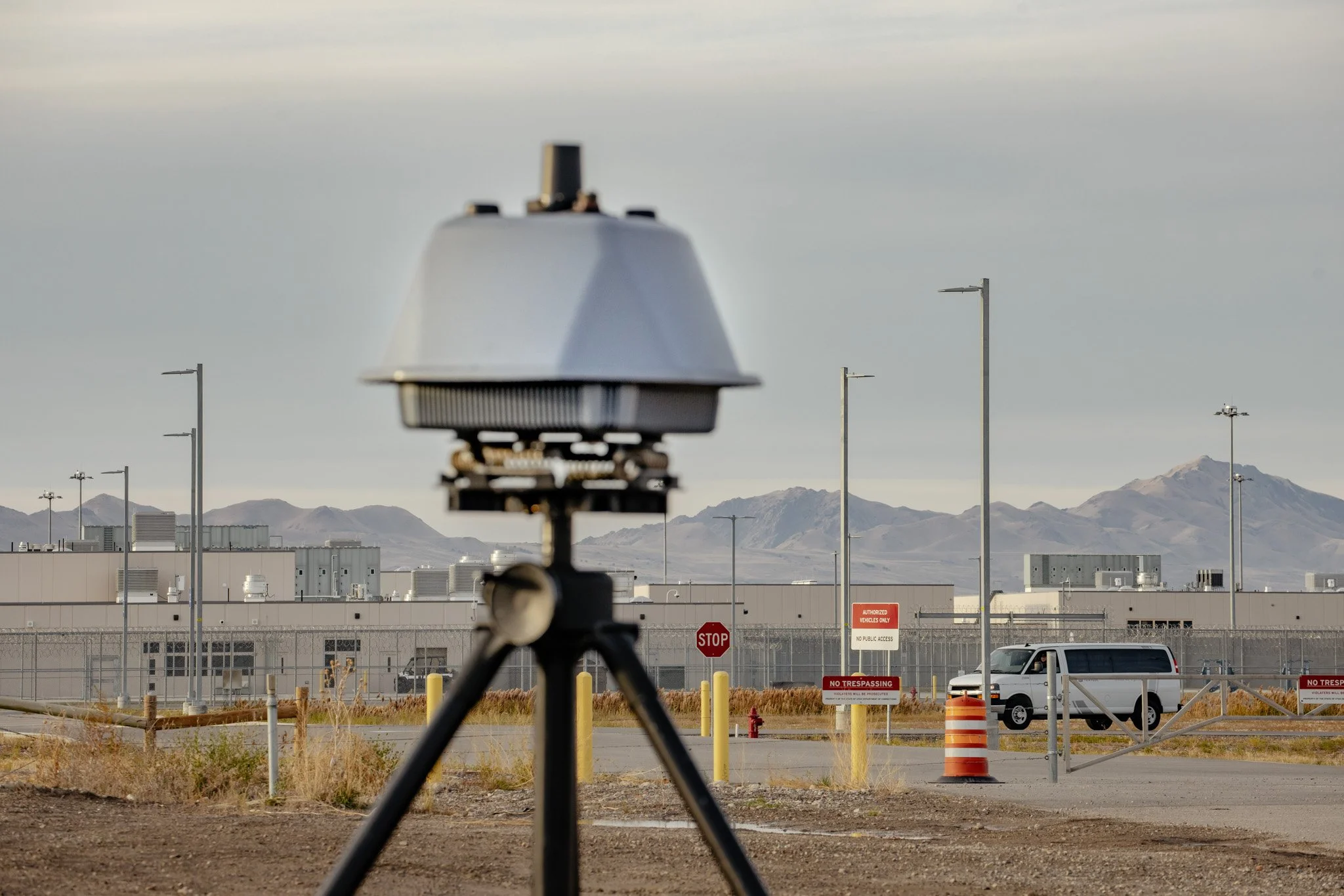
Physical ground-based security requires counter-drone augmentation
The Prevailing Security Mentality Is No Longer Adequate
Prior to the now ubiquitous drone threat, security teams tasked with protecting critical infrastructure concentrated on several ground-based measures that were primarily human-centric:
Physical barriers
Foot patrols
Security cameras
Access restrictions
Acoustic and vibration sensors
The current reality is that a single inexpensive drone can now easily bypass every one of these security staples. A UAS can overfly a reinforced perimeter, conduct reconnaissance of a facility, map its layout, record security infrastructure, and return to its operator without triggering a single alarm.
In more concerning scenarios, it can deliver a payload, threaten large-scale public gatherings, infiltrate networks, shut down airports, and destroy infrastructure.
While traditional security measures certainly continue to have worth against ground-based threats, they now require immediate augmentation to account for the UAS dimension.
| Consideration | Traditional Security Model | Airspace Intelligence Security Model |
|---|---|---|
| Focus | Two-dimensional. Gates, fences, CCTV, ground-level sensors, and access control | Three-dimensional. Hemispherical low-altitude airspace surrounding the facility |
| Operational stance | Reactive. Respond after an intrusion sensor is triggered or barrier breached | Predictive. Early detection, behavioral analysis, and continuous monitoring |
| Primary threat | Human intruders and vehicle incursions | Surveillance, reconnaissance, payload delivery, cyber-attacks, kinetic strikes, and disruption |
| System architecture | Independent, isolated security systems | Multi-sensor, AI-driven security ecosystems |
| Awareness boundary | Ground-based | Hemispheric |
The Economics Have Shifted Alongside the Threat Profile
A key factor in this emerging hemispheric security mindset is one of economics. Critical infrastructure security has historically been predicated on the question: how likely is a threat to occur? That question is now: what’s the cost and consequence when it does?
Drone incursions have become a highly asymmetric security problem. The barrier to entry is low in effort and cost, while the operational disruption and potential risk to people they can create can be immense.
A sub-$1,000 UAS can trigger full airspace closures, emergency response, operational delays, infrastructure damage, shutdowns, and regulatory scrutiny. All inflicting total incident costs that dwarf the exceptionally low cost of the platform that caused it.
Even when an incursion ends without physical damage, intelligence loss, or personal injury, the organization has already paid potential millions in downtime, diverted resources, insurance repercussions, and reputational exposure.
It’s imperative that this exploitable economic UAS risk is addressed and accounted for.
Different Infrastructure Sectors Face Different Airspace Risks
While every critical infrastructure operator faces the same essential challenge, specific risks and appropriate responses vary by sector.
| Sector | Key Security Risks |
|---|---|
| Airports | For airports, the risk is primarily operational disruption. Even a single drone sighting can trigger airspace restrictions, delays, diversions and significant financial consequences, while creating potential risks to passenger and aircraft safety. In more severe circumstances, the threat can escalate to a deliberate kinetic attack. |
| Utilities and Water Infrastructure | Utilities often manage vast geographic footprints with remote assets and limited physical oversight. Substations, reservoirs and other dispersed infrastructure can be difficult to monitor continuously, creating opportunities for remote reconnaissance, asset interference and disruption of critical services. |
| Energy Facilities | Power generation facilities, refineries and other energy assets are heavily protected on the ground but remain vulnerable to airborne observation and potential payload delivery. The consequences of such disruption can extend well beyond the facility itself, potentially impacting generation capacity and entire energy grids. |
| Telecommunications | Cell towers and network infrastructure are increasingly distributed and geographically dispersed. Maintaining situational awareness across multiple remote sites creates unique security challenges, including the potential for infrastructure surveillance, signal interference and disruption to communications networks, risks that can’t be addressed by ground-based systems alone. |
| Ports and Maritime Infrastructure | Ports face a complex mix of security, logistics and customs enforcement challenges. Drones can be used for reconnaissance, contraband delivery or intelligence gathering while operating across large coastal environments. The consequences range from undetected smuggling operations to exposed shipping infrastructure and disruption to logistics operations. |
| Public Venues | Stadiums, entertainment precincts and major events face a different challenge altogether. The concern is often less about infrastructure damage and more about public safety, crowd disruption and operational continuity. This demands both fixed-site CUAS solutions for arenas or stadiums and mobile rapid-response capability for individual security personnel. |
While different environments and sectors require different solutions and responses, they all share one common requirement: comprehensive hemispheric airspace intelligence.
Security Teams Can't Respond to Threats They Can't See
The challenge isn't simply deploying a detector. It's establishing persistent awareness of what's happening in the airspace and RF environment surrounding a facility at all times.
In practice, low-altitude airspace is one of the most technically demanding environments to monitor, and the limitations of individual sensor modalities are not widely understood outside the C-UAS community.
A UAS can present multiple simultaneous signatures. It may emit RF control signals, receive GNSS (Global Navigation Satellite System) positioning data, transmit a live video feed, and broadcast Remote ID. It may also do none of these things.
The detection challenge isn't isolated to identifying a known drone type in the moment. It's about maintaining persistent airspace awareness across an entire threat spectrum, from careless hobbyists to purpose-built adversarial platforms, so that security teams always have the operational picture they need before a situation demands a response.
Navigating the Next Security Horizon
The organizations most exposed to the airspace visibility gap are often not those with weak overall security planning. They're organizations that have built thoughtfully designed, well-funded ground-level security systems, but have simply failed to keep pace and extend that same rigor skyward.
Closing this airspace security gap isn't about scrapping current security measures. It's about extending and integrating counter-UAS capability directly into existing security procedures and systems. Another layer must be added.
The three baseline requirements for this airspace security evolution are clear:
1) Prioritize Passive Detection
Many critical infrastructure environments require non-intrusive security technologies that do not interfere with surrounding communications systems. Passive RF detection enables operators to identify and track drone activity without emitting signals or affecting nearby operations.
2) Demand Layered Architectures Bound by Sensor Fusion
No single sensor provides complete coverage. The future of airspace security lies in layered CUAS systems that combine RF sensing, radar, electro-optical systems and command-and-control software to form a unified operational picture.
3) Establish Response Frameworks Before an Incident Occurs
Detection is only part of the challenge. Security leaders must thoroughly understand the legal, regulatory and operational constraints governing drone response in their region or sector before an incident takes place. This is especially true when it comes to RF jamming technology or radar.
The organizations that establish those frameworks in advance will make faster and more informed decisions before consequences are realized.