

The Future of Counter-UAS Will Be Defined by Interoperability
Why Open Architecture and Standards-Based Ecosystems Are Reshaping Modern Airspace Security
For years, the counter-UAS market has largely been driven by a familiar conversation: detection range, sensor performance, disruption capability, and individual hardware specifications.
That conversation is changing.
As drone threats continue to evolve in both sophistication and scale, operators are increasingly confronting a far more complex challenge than simply detecting unmanned aircraft. Modern airspace environments are now saturated with data, layered sensing technologies, competing operational priorities, and rapidly changing threats that do not conform neatly to a single technology stack.
The next phase of counter-UAS evolution will not be defined solely by who has the best standalone sensor. It will be defined by who can make disparate technologies work together operationally.
Across Europe and NATO-aligned defense environments, interoperability is rapidly moving from a technical preference to an operational requirement. Governments, military organizations, and critical infrastructure operators are increasingly recognizing that future airspace security environments cannot rely on isolated systems operating independently. They require layered ecosystems capable of sharing information, correlating detections, and supporting coordinated decision-making across increasingly complex operational environments.
This shift is reshaping the future of counter-UAS. And it is happening quickly.
Recent multinational exercises and technical integration events have reinforced a broader industry reality: modern defense environments are becoming increasingly multi-vendor by necessity. No single technology solves every operational challenge across every terrain, mission profile, or threat environment. Radar, RF sensing, EO/IR tracking, acoustic technologies, command-and-control (C2) platforms, and AI-enabled analytics each contribute unique operational value. The challenge is no longer simply deploying these technologies independently. The challenge is enabling them to operate cohesively within a unified operational architecture.
This is where standards-based interoperability frameworks such as SAPIENT are becoming increasingly important.
This industry shift was further reinforced during NATO’s Technical Interoperability Exercise (TIE) 2026 in The Netherlands, where DroneShield successfully connected with 21 Fusion and 31 Edge nodes using STANREC 4869 (Countering Class I UAS), demonstrating the growing operational importance of standards-based interoperability across layered counter-UAS environments.
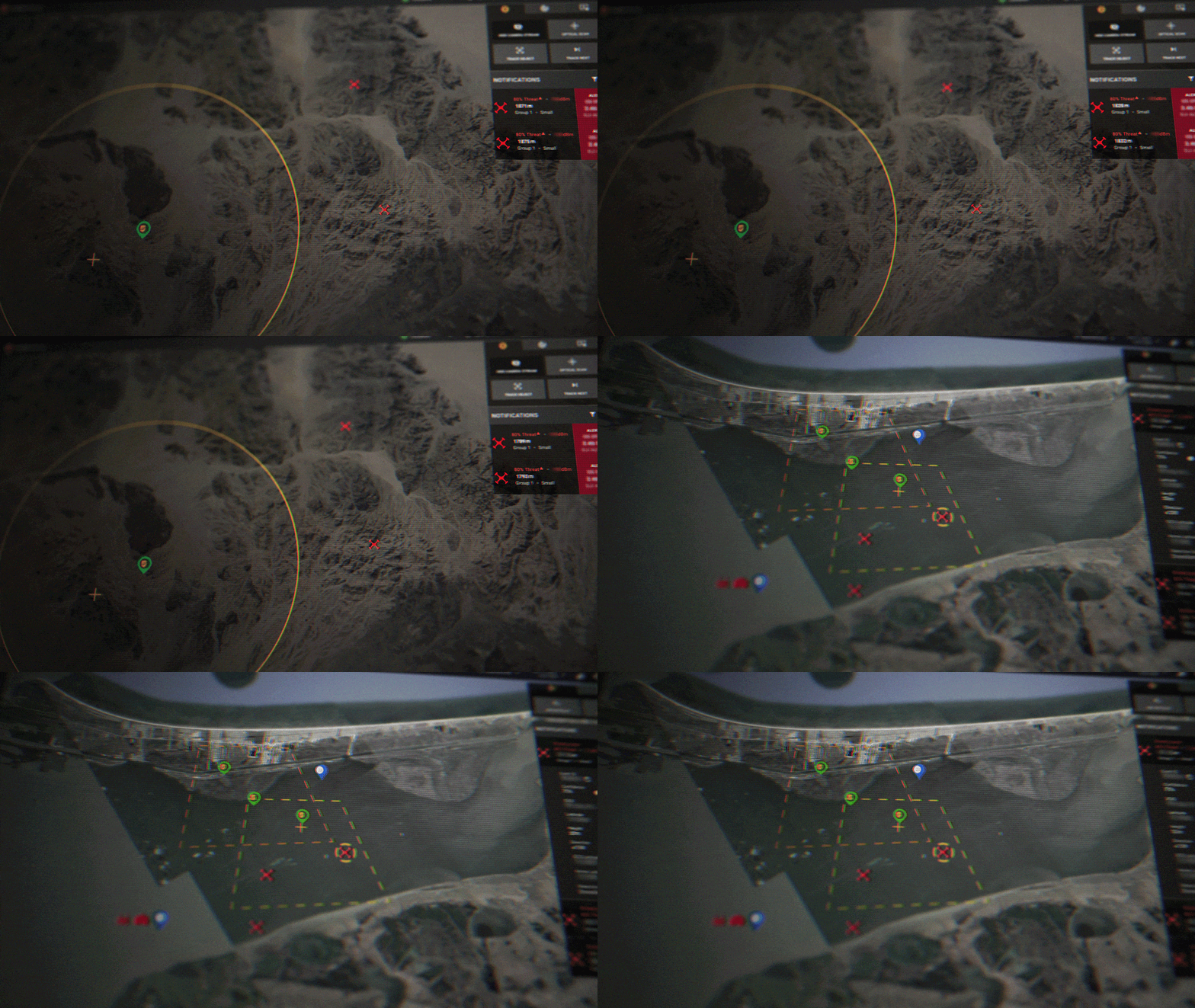
Image: DroneShield’s command-and-control (C2) platform, DroneSentry-C2
As governments modernize layered defense environments, standards-based approaches are helping enable communication between sensors, command-and-control platforms, and operational response layers across diverse ecosystems. More importantly, they are helping reduce operational friction in environments where speed, coordination, and decision confidence increasingly matter as much as raw detection capability.
This evolution reflects a much broader transformation taking place across defense and security environments worldwide.
Drone threats themselves have evolved dramatically. What was once considered a niche battlefield concern now affects military installations, airports, borders, public events, seaports, critical infrastructure facilities, and urban environments globally. Commercially available drones are becoming more autonomous, more accessible, and more difficult to detect through conventional security approaches alone. At the same time, operators face growing volumes of airspace activity, making rapid and accurate threat assessment significantly more difficult.
In these environments, fragmented systems create operational burden.
Operators cannot afford to manage disconnected streams of RF detections, radar tracks, EO feeds, and acoustic alerts independently while simultaneously making real-time decisions under pressure. Modern airspace security increasingly requires systems capable of correlating information, prioritizing alerts, and reducing cognitive overload for operators tasked with protecting increasingly vulnerable environments.
This is why the industry conversation is shifting from detection alone toward decision advantage.
The future of counter-UAS will likely belong to organizations capable of transforming distributed sensor activity into actionable operational intelligence. This is driving growing emphasis on data fusion, AI-enabled analytics, scalable command-and-control environments, and layered ecosystem architectures capable of supporting real-time operational coordination.
Importantly, this is not simply a technology trend. It is becoming a procurement and operational trend as well.
Across Europe in particular, governments are accelerating investments in sovereign defense capability, resilient infrastructure, and interoperable security architectures. NATO-aligned modernization efforts are increasingly prioritizing solutions capable of operating effectively within broader coalition and multi-domain environments. Procurement conversations are evolving beyond standalone product specifications toward broader questions around scalability, interoperability, operational flexibility, and long-term adaptability.
Organizations are increasingly asking:
Can this capability evolve alongside emerging threats?
Can it operate effectively within a layered ecosystem?
Can it reduce operator workload instead of increasing it?
Can it support coordinated operations across multiple environments and stakeholders?
These questions are shaping the future direction of the market. For the counter-UAS industry, this marks an important transition point.
The market is moving beyond the era of isolated hardware discussions and into an ecosystem-driven phase where interoperability, operational coordination, and scalable decision-making architectures are becoming central to effective airspace security.
In many ways, the industry is undergoing the same evolution seen across broader defense modernization initiatives: the growing realization that information superiority and operational coordination are becoming as strategically important as the hardware itself.
The organizations best positioned for the future will not simply be those capable of detecting threats. They will be the ones capable of connecting technologies, contextualizing data, and enabling faster, more informed operational decisions across increasingly complex airspace environments.
That is where the future of counter-UAS is heading. And interoperability is becoming one of the foundations upon which that future will be built.