

The Evolution of the Shahed Threat
Shaheds are best described as a class of low-cost, one-way attack unmanned aerial vehicles (UAVs) that share a common airframe. However, as highlighted in recent conflicts, Shaheds increasingly vary in how they navigate, communicate, and complete their mission, which means that while they may look similar from the outside, the way they operate internally can differ from one variant to another.
Some rely on satellite navigation, while others are designed to continue operating with limited or degraded signals. Some emit radio frequency (RF) signals for most of their flight, while others reduce or manage those emissions, particularly when they approach the target. Some follow fixed routes, while others incorporate onboard processing that allows for adjustments in the final phase of flight.

Image: The Shahed-136 are one-way-attack (OWA) unmanned aerial vehicles (UAVs), often called ‘kamikaze drones’ or ‘suicide drones’ in the media
A System That’s Designed to Vary
The baseline Shahed remains relatively straightforward. It follows pre-programmed routes, uses satellite navigation, and produces recognizable acoustic and RF signatures. Under these conditions, it can be detected and, in many cases, disrupted. However, this is no longer the only configuration that needs to be considered.
Recovered systems and operational reporting indicate that guidance and navigation are becoming more flexible. Some variants appear to incorporate multiple navigation pathways, combining satellite inputs with inertial systems. Others reduce or manage their RF emissions during critical phases of flight. There is also increasing evidence of onboard processing providing terminal guidance, which reduces reliance on external inputs as the system approaches its target.
None of these changes fundamentally alter the cost or scalability of the platform; what they do is make its vulnerabilities less predictable. From a defensive perspective, that is the more consequential shift. Systems that depend on a known weakness are easier to counter. Systems that can operate across multiple modes require a different approach.
From Disruption to Assured Effects
RF detection and jamming work when baseline drone configurations emit signals, even if only in the early stages of flight. The difference now is that drones are more frequently operating outside of those pre-conditions.
What operators are seeing more often is inconsistency in how these systems behave. A drone may emit signals early in its flight and then go quiet as it gets closer to its target. It may start by relying on satellite navigation but can continue flying even when that signal is disrupted. In some cases, the UAS doesn’t need much external input at all in the final phase. That change in reliance on signal emission changes what conventional signal disruption achieves.
Instead of reliably stopping the threat, signal disruptors may simply change the drone’s behavior,push the drone off course, delay it, or make its path less predictable. Sometimes a disruption to flight path is enough to neutralize physical harm to an intended target. Other times, it isn’t. And that’s where the challenge sits. From an operator’s perspective, the question is no longer did we disrupt it?” it’s “did we actually stop it?”
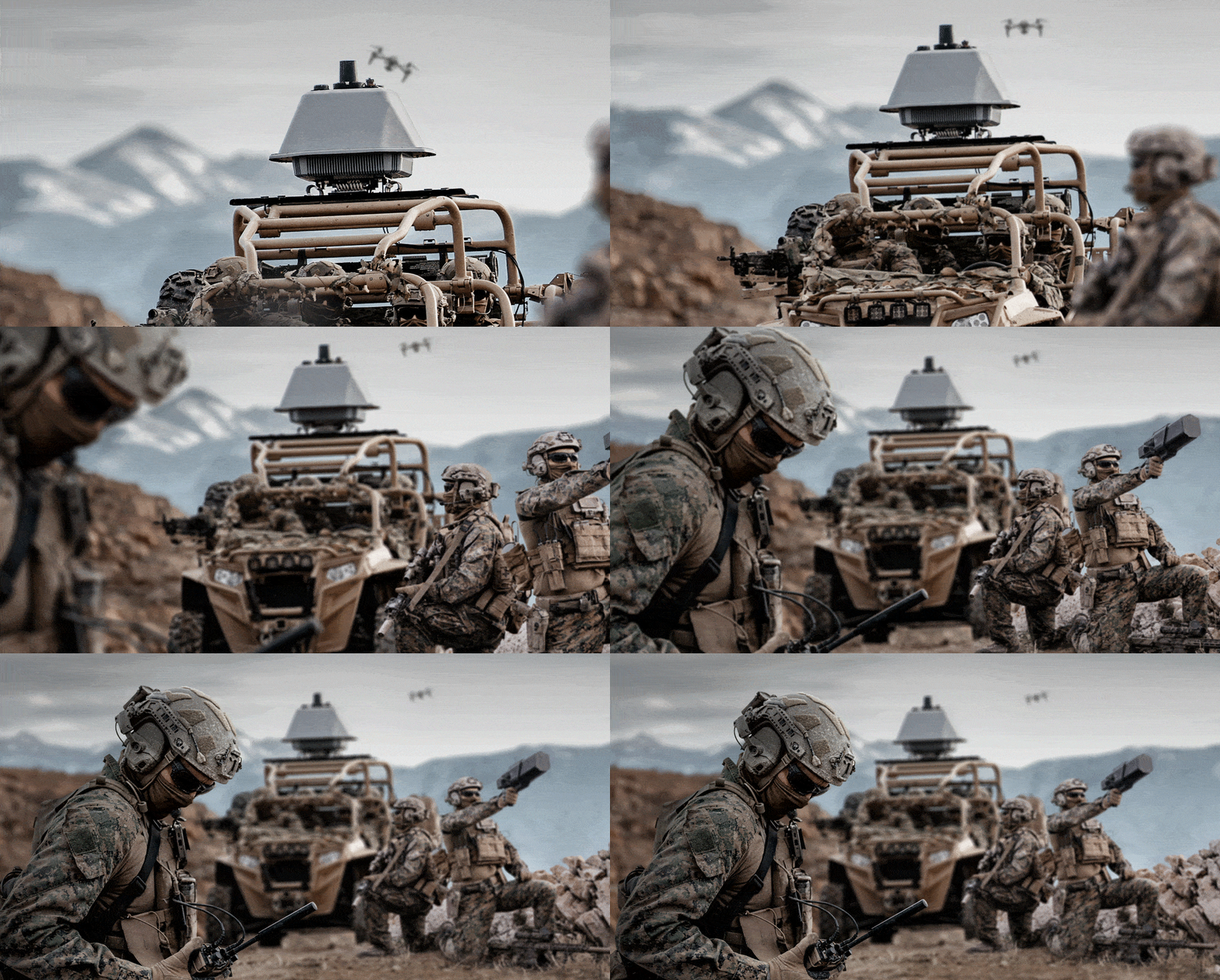
Image: End-to-end counter-drone solutions (L-R): RfPatrol Mk2, DroneSentry-X Mk2, DroneGun Mk4
In fast-moving scenarios and critical situations, that distinction matters. There isn’t always time to wait and see how a disrupted system behaves. If the answer isn’t clear, the risk remains. That’s why signal detection and signal disruption is no longer a complete solution. It’s still the first move. It’s fast, efficient, and it can reduce the pressure of an incoming threat. To be fully effective against all types of drones, however, a protective system requires layered sensors that work cooperatively to provide mitigation confidence.
Combining different sensing methods and, when needed, applying a physical intercept to ensure the threat is stopped ensures comprehensive airspace awareness and enables accurate targeting, whether physical or electronic. The shift isn’t away from electronic warfare. Rather, leveraging it for what it does best and supplementing where there are gaps. Disruption shapes engagement. It creates opportunity, but increasingly, it’s the other layers that are responsible for finishing it.
The Real Constraint is Time
Shahed-type systems are often described as difficult to detect. In practice, the issue is less about detectability and more about timing. These systems fly low, use terrain to their advantage, and present relatively small radar signatures. They are typically detected, but often later than operationally ideal. Track quality may take time to stabilize. Identification may require additional confirmation. All of this compresses the time available to respond.
Under these conditions, relying on a single sensor or a single method of defeat expands risk of defense mission failure. What matters is the ability to maintain a coherent track as conditions change and to act on that information quickly. That requires systems that can correlate data inputs from RF, high-fidelity radar, and electro-optical sensors into a unified operational picture.
From Detection to Decision to Action
As timelines compress and the threat diversifies, the performance of a counter-UAS system is less about any individual sensor or effector and more about how quickly it can move from detection to decision to action. This is where command-and-control becomes central.
A system that can fuse inputs from multiple sensors, maintain track continuity, and support rapid classification creates the conditions for effective response. Without that, even capable sensors and interceptors operate in isolation, increasing response time, and reducing overall effectiveness.
No single sensor and no single effector is sufficient across the full range of scenarios now being observed. Electronic warfare, radar, electro-optical tracking, and kinetic effectors each have a role, but that role depends on the specific characteristics of the target and the conditions of the engagement. A system that can integrate and coordinate these layers, rather than rely on one, is better positioned to maintain performance as the threat evolves.
For this reason, DroneShield’s solutions cover a range of ‘detect and defeat’ options that can be layered and combined into custom arrays to suit specific scenarios. For example, DroneSentry is an autonomous, modular detection and countermeasure solution that provides a range of deployment configurations including RF, optical, acoustic, and radar.
The Growing Role of Kinetic Interceptors
One of the more notable developments is the increasing focus on kinetic interceptors, including interceptor drones, as part of the counter-UAS toolkit. This is driven by two factors.
The first is reliability. When a system operates with reduced emissions or limited reliance on external navigation, disruption alone may not be sufficient to stop it. A physical intercept provides a level of certainty that other methods cannot always guarantee.
The second is scalability. Shahed-type systems are often used in numbers. Defending against that requires response mechanisms that can scale without placing excessive burden on operators or relying exclusively on high-cost traditional air defenses.
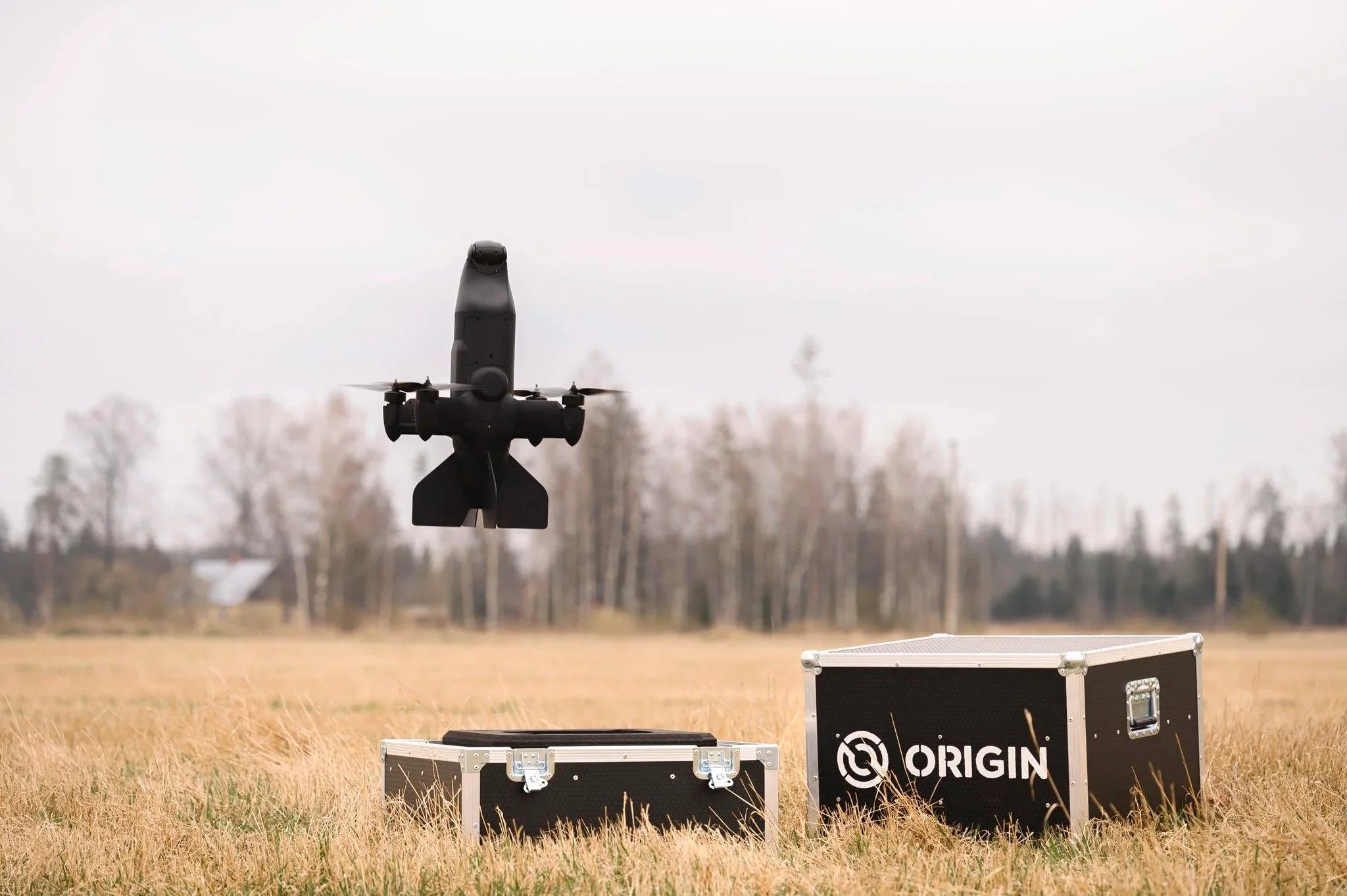
Image: ORIGIN BLAZE kinetic interceptor
Interceptor drones, particularly when integrated into a broader system, offer a way to address both challenges. They can be deployed rapidly, assigned based on real-time tracking data, and used to engage targets that are not affected by electronic disruption. However, their effectiveness is directly tied to the system they operate within. Without accurate tracking, timely decision-making, and coordination across sensors, interceptors become reactive rather than proactive. With the right integration, they become part of a coordinated response that can operate at the speed required by the threat.
To this end, DroneShield recently partnered with Origin Robotics to include ‘BLAZE’ kinetic interceptors in the suite of solutions on offer, providing decisive threat neutralization coverage. Such Kinetic defeat options are invaluable when traditional methods such as signal disruption aren’t viable.
Why Architecture Now Determines Effectiveness
The evolution of the Shahed threat highlights a broader shift in counter-UxS. The problem is no longer centered on a single platform with a known set of vulnerabilities. It is defined by a class of systems that reduce reliance on any one input and adapting incrementally over time.
In that environment, effectiveness is determined less by individual capabilities and more by how those capabilities are combined. Systems that bring together multiple sensing modalities, fuse data in real time, and enable coordinated response across electronic and kinetic layers are better positioned to operate under these conditions. Systems that rely on a single method of detection or defeat are more likely to encounter gaps as the threat continues to evolve.
Looking Ahead
The trajectory is clear. Modern drone systems will continue to incorporate greater autonomy, more flexible communications, and reduce dependence on any single point of failure. As that happens, counter-UAS must move in parallel toward layered, interoperable architectures that can adapt to variation and operate within increasingly compressed timelines.
The question is no longer how to counter a specific drone. It is how to build a system that can respond to a class of threats that are designed to change.