

Modern Military Installations Demand Persistent RF Awareness
Recent global conflicts have demonstrated time and again that highly capable and expendable drones can bypass traditional physical security to survey, disrupt, and destroy high-value assets with minimal risk to the operator.
Persistent ultra-wideband RF intelligence across every operating environment, whether temporary, fixed, or in flux, is now a baseline requirement, not an upgrade.
The Myth of the Secure Rear Area
Military doctrine has traditionally made a distinction between the “forward edge” of the battle area and the “secure rear echelon”. Recent examples have shown that the distinction between forward operating areas and rear-echelon facilities is becoming increasingly blurred as long-range drones expand the reach of reconnaissance and strike operations.
Advances in highly iterative DIY and military UAV technology combined with adaptive engineers and fast-learning operators have exposed these once “safe” areas, far from the front lines. Cheap long-range loitering munitions and advanced reconnaissance drones have turned rear-area bases from refuges into active targets.
This is where traditional perimeters, ground defenses, and sheer distance can falter. The first step to counter-drone military installation security is flexible, distributed and persistent RF awareness.
Passive Rf detection can provide one of the earliest indicators of drone activity by identifying RF emissions associated with platform activation and operation, before it breaches a perimeter or appears on radar.

OWAs have redefined the frontlines
One-Way Attack Drones Transform UAVs into Deep Strike Ammunition
For years, drones were expensive, niche systems treated as reusable and recoverable assets, deployed for recon or to fire projectiles of their own, including remotely piloted aircraft systems (RPAS) like the MQ-1 Predator. That calculus has well and truly shifted. There’s been a marked move away from recoverable RPAS platforms, which are vulnerable to traditional air defense systems.
Increasingly, one-way attack drones (OWA) like Shahed-type UAVs are being employed as expendable precision effects rather than recoverable aircraft systems. Russia has escalated from approximately 200 Shahed launches per week in September 2024 to more than 1,000 per week by March 2025.
Deep strike capability has followed and become commonplace. Rear-area installations that sat outside the meaningful threat range just eighteen months ago are now viable targets for any adversary that can produce at scale.
The detection problem is specific and serious. OWA drones are engineered to minimize emissions, with many relying on:
GNSS and inertial navigation for terminal guidance
Pre-programmed flight paths with no operator input
Optical sensors and cellular networks for targeting and telemetry
No sustained RF control link in the terminal phase
While RF intelligence remains the core of modern CUAS, detection architecture built solely around intercepting a control link will miss these UAVs entirely.
The response is layering. Persistent and dispersed broad-spectrum RF awareness covering the pre-launch and early-flight phase, combined with radar and EO/IR for terminal detection, and potential kinetic interception, is how C-UAS architecture closes the airspace awareness gap.
The Ground-Level Perimeter Problem
Military installations tend to be exceptionally well-defended at ground level. Access control, physical barriers, perimeter lighting, guard force, and sensor arrays offer mature traditional protection that are predicated on decades of experience. However, these defenses were primarily created for two-dimensional security.
A drone operating in the air littoral has already bypassed every one of them and is now operating inside defended space.
Depending on the platform and mission profile, the drone may operate without triggering traditional perimeter security measures. And in the time it takes a guard force to respond to a visual sighting or audio cue, intelligence has already been captured and transmitted.
The critical insight from recent operational experience, taken from Ukraine and the Middle East, is that drone reconnaissance can precede any kinetic action by hours, days, or weeks.
By the time an installation detects the incoming strike, the surveillance phase that informed it has long since concluded. Persistent and passive ultra-wideband RF awareness can detect and lead to the potential disruption of intelligence gathering before it’s complete, while also offering advanced warning that the installation has been pinpointed by an adversary.
Flight Line Drone Security Protects Millions with RF Vigilance
The flight line or apron is where the cost asymmetry between attacker and defender is most extreme.
Aircraft parked on a flight line are stationary, high-value, and concentrated. They typically can’t be dispersed on short notice, nor can they easily and convincingly be concealed from low altitude observation. And of course, the adversary doesn’t need to be anywhere remotely proximate to observe them.

Flight lines are high value UAS targets
A commercial UAS with a 4K optical sensor can characterize aircraft type, exact location, operational state, and asset numbers, at standoff distances well beyond the detection range of conventional perimeter systems. Even low-cost commercial drones can create disproportionate operational and financial consequences when employed against high-value assets.
Radar remains a critical component of layered C-UAS architectures. However, flight line environments can present challenges for any single sensor modality, including clutter, infrastructure density, and operational constraints. This is why military operators increasingly combine radar with passive RF, EO/IR, and other sensing technologies in constrained in aviation environments.
Both acoustic and optical detection require proximity. Acoustic sensors lose effectiveness rapidly beyond 150 to 200 meters against small rotary-wing platforms in environments with any background noise from nearby equipment or aircraft operations. Optical surveillance requires line of sight, degrades in poor light or adverse weather, and depends on an operator already looking in the right direction.
Baseline ultra-wideband RF detection and line of bearing awareness change the dimensions of these issues. A drone's control link and telemetry emissions can be detected at ranges that significantly exceed the visual acquisition distance of the platform itself. Direction-finding narrows the bearing of origin, while protocol classification identifies the platform type and, in some cases, the controller location. This is actionable intelligence that arrives before the platform is visible and before it’s completed a single pass.
Expeditionary Drone Detection Must Be Swift and Mobile
One of the most perilous and mission critical phases of expeditionary deployment is the initial establishment of a Forward Operating Base (FOB). In these contexts, troops are focused on logistics, communications, and constructing basic infrastructure. This means that force protection is dispersed across multiple simultaneous tasks and the local threat picture, including UAS presence, is temporarily uncharacterized.
Adversaries understand this. The initial establishment phase of a new operating location can represent a period of heightened vulnerability while force protection measures and situational awareness capabilities are being established.
Small commercial drones have been deployed to survey newly occupied positions in Syria, Iraq, Ukraine, and Yemen within hours of establishment, providing intelligence subsequently used to coordinate ground or aerial action before the installation had time to develop a coherent defense.
Portable and passive RF sensors address this directly. Vehicle-mounted or mast-mounted systems that can scan the spectrum within minutes of arriving on site turn every convoy asset into an early-warning node, without advertising the installation's presence and without the logistical requirements of active radar. They provide the baseline electromagnetic awareness that all subsequent force protection decisions depend on.
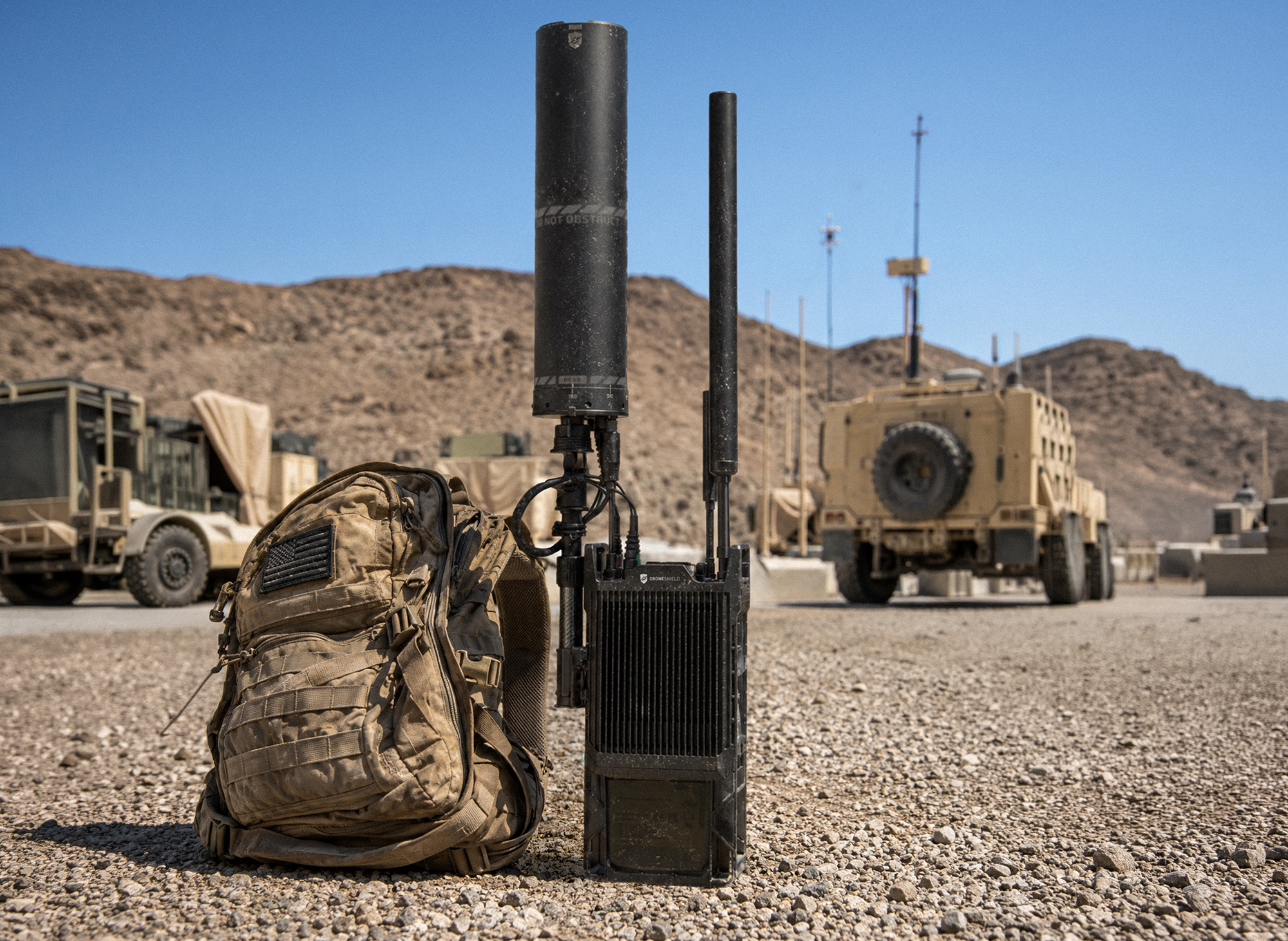
RF intelligence needs to be portable, passive, and powerful
Temporary Operating Environments Require Fluid RF Security
Military forces increasingly operate from shifting fronts and new environments. Temporary checkpoints, patrol bases, and assembly areas are sometimes occupied for hours or days, not months.
The prevailing assumption is that this brevity reduces exposure. This assumption that adversaries lack the response speed to target a position that will only exist for 24 to 48 hours has been consistently invalidated. In reality, commercial drones with autonomous flight modes can survey a checkpoint within minutes of its establishment. Such intelligence (transmitted in near-real time) can be acted on faster than a temporary position can be reinforced or relocated.
The problem compounds under operational pressure. Personnel in temporary operating environments rapidly manage multiple simultaneous tasks with no specialist support available. The ideal RF awareness solution should be:
Man-portable and self-contained
Rapidly deployable without infrastructure dependency
Designed for minimal operator burden
A compact, passive RF intelligence solution that a single operator can activate and monitor from a command-and-control display while managing other tasks is a fundamentally different operational concept than fixed-site infrastructure.
The RF Awareness Threat Matrix
The table below maps common military environments to primary RF challenges, and the detection outcomes enabled by persistent awareness.
| Environment | Primary RF Challenge | What Persistent Awareness Enables |
|---|---|---|
| Permanent Installation |
|
Continuous baseline and early warning before a platform reaches the perimeter |
| Flight Line |
|
Direction-finding and protocol ID before visual acquisition, without avionics interference |
| Forward Operating Base |
|
Vehicle-portable passive sensing that's operational within the first hour of site occupation |
| Temporary Site |
|
Scalable and dismounted RF nodes providing a flexible detection perimeter that expands with the mission |
The Operational Limitations of Periodic Monitoring
The shared potential failure across these common operating environments isn’t inadequate sensor capability, it’s intermittent operation.
An RF monitoring system activated for a two-hour sweep and then shut down provides near-zero deterrent value against an adversary with basic operational security awareness.
Adversaries conducting systematic reconnaissance don’t operate on a schedule that accommodates monitoring windows. Drone activity is deliberately timed to exploit known or assumed awareness gaps such as the interval between guard rotations, periods of high radio traffic that mask a drone's control link, or night hours when visual surveillance degrades.
The error of periodic monitoring lies in the fact that it creates a predictable rhythm. Persistent monitoring, however, eliminates the risk-exposures these rhythms create. A reconnaissance drone making multiple short passes over several consecutive periods generates a series of indicators that, assembled over time, reveal a systematic intelligence collection effort. While periodic monitoring captures isolated data points, continuous airspace awareness stitches together a comprehensive threat picture.
The Move to Next-Generation Ultra-Wideband RF Detection
Every operating environment shares a common thread: adversaries can establish situational awareness before defenders detect their presence.
Addressing these challenges requires sensing technologies capable of operating across fixed, expeditionary, and temporary environments while contributing to a broader layered defense architecture.
RfRecon was developed to support these requirements through passive ultra-wideband RF detection, line-of-bearing awareness, and deployment flexibility across both fixed and mobile operating environments.
Crucially, with its RfAI-3 detection engine, it’s designed to detect and classify RF activity across a broad spectrum without relying on predefined signal catalogs.
Within a layered architecture, RF awareness complements radar, EO/IR, and command-and-control systems by providing additional context and earlier visibility into activity occurring within the electromagnetic environment.
The Electromagnetic Perimeter Is Now as Critical as the Physical One
The drone threat to military installations isn’t emerging. It’s present, documented, and continues to develop at great pace in capability and accessibility.
Installations adopting layered airspace awareness strategies are increasingly prioritizing the electromagnetic environment alongside traditional physical security measures. Operators know what signals are in their airspace, they know when those signals are anomalous, and they know this continuously.
As drone capabilities continue to evolve, military organizations are placing greater emphasis on understanding the electromagnetic environment surrounding their operations. Persistent RF awareness is increasingly becoming a foundational component of layered airspace security strategies across every fixed, expeditionary, and temporary operating environment.