

Sydney, Australia – 7 April 2026 – DroneShield, a global leader in advanced counter-unmanned systems (CUxS), today announced its Q2 2026 software release, delivering coordinated updates across its RF sensing, AI, ATAK-CIV plugin, and command-and-control (C2) platforms.
DroneShield’s Q2 release is focused on a single outcome: enabling operators to make faster, more confident decisions in complex and contested airspace environments.
The release comes amid a sharp rise in global drone activity, with recent industry and government reporting highlighting the increasing use of both low-cost commercial drones and long-range fixed-wing platforms across conflict zones, critical infrastructure, and public safety environments. In parallel, studies from U.S. oversight bodies have pointed to significant gaps in counter-drone readiness, particularly across civilian infrastructure such as airports and urban environments.
As drone threats scale in volume and complexity, the challenge is no longer detection alone, but how effectively that data is prioritized, shared, and acted upon.
Reducing Cognitive Load Through Unified Classification and Prioritization
At the core of the release is a new identity and prioritization framework designed to reduce operator burden in high-tempo environments.
Drones can now be automatically classified as Friendly, Neutral, Hostile, or Unknown using serial-number-based identification and Remote ID inputs. These classifications are applied at the sensor level and carried consistently through to ATAK-CIV and C2 environments.
Combined with new emitter prioritization, operators are presented with the most relevant threats first, while low-value or background signals are suppressed. The result is a cleaner, more actionable operational picture, enabling faster interpretation and response.
Real-Time RF Awareness Inside ATAK
DroneShield has relaunched its ATAK-CIV plugin as RfLink, a fully reengineered system designed to deliver shared RF awareness across distributed teams.
RfLink enables:
Real-time RF detection visualization within ATAK-CIV
Line-of-bearing rendering and directional awareness via DroneSentry-X Mk2
Enhanced Cursor-on-Target data sharing across users and devices
Seamless propagation of identity tagging and classification rules
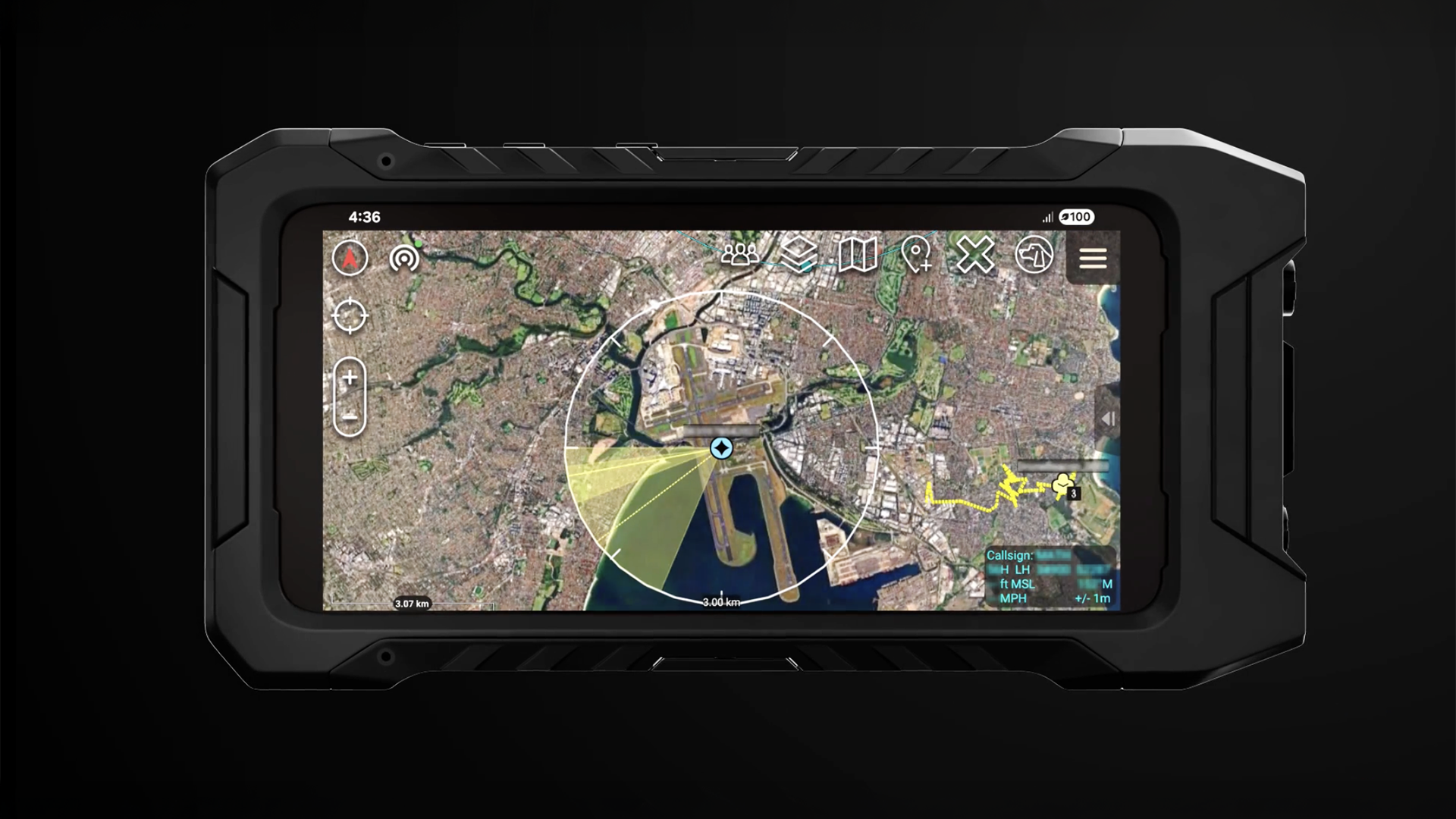
Image: DroneShield has relaunched its ATAK-CIV plugin as RfLink
ATAK-CIV users can receive consistent data from RfLink users without installing the plugin. RfLink creates a shared, real-time understanding of the RF environment, even across dispersed teams and challenging terrain. Additional features, including Wi-Fi filtering and improved overlay management, reduce visual clutter and help operators maintain focus on genuine threats.
This newly designed ATAK-CIV plugin allows teams to operate from a single, aligned view of the RF environment, improving coordination, reducing miscommunication, and enabling faster and threat localization across distributed units.
Embedded Enhancements: Faster Interpretation and Controlled Response
Updates to RfDeviceManager (RfDM) and RfAI embedded software introduce a redesigned interface and expanded detection intelligence, improving both usability and performance at the sensor level.
The new interface maintains persistent visibility of detection and disruption data, allowing operators to adjust settings without losing situational awareness. Alignment with DroneSentry-C2’s interface also reduces training overhead across the ecosystem.
Key enhancements include:
Expanded RfAI emitter library with new drone and controller profiles
Improved Remote ID performance and stability
Emitter prioritization to suppress low-value signals
Disruption power control by frequency band, enabling precise and compliant operation in regulated or sensitive environments
Together, these updates enable operators to move more efficiently from signal detection to calibrated response, particularly in complex urban or regulatory-constrained environments.
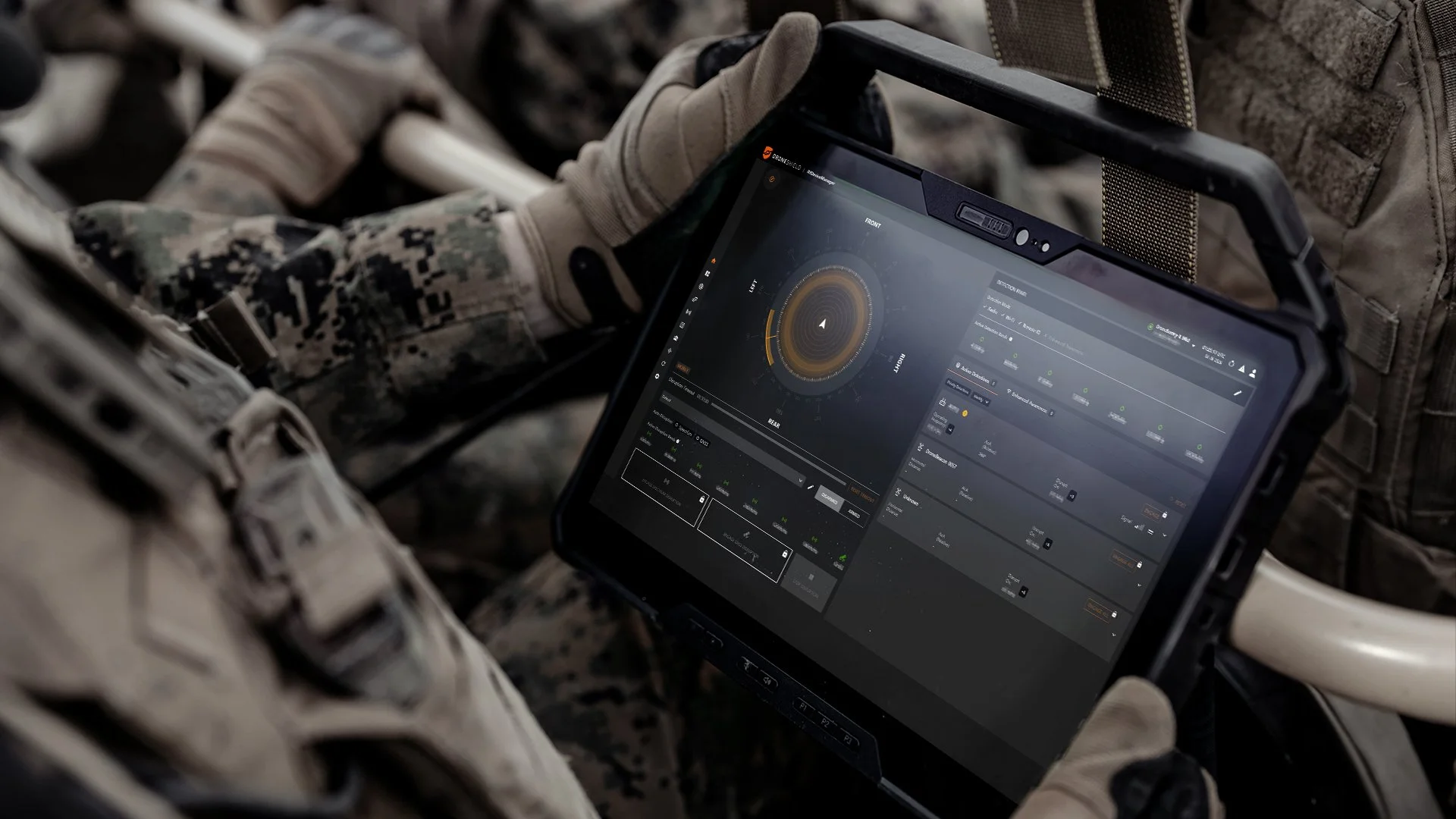
Image: RfDeviceManager (RfDM) introduces a redesigned interface
DroneSentry-C2: Greater Deployment and Airspace Clarity
DroneShield’s DroneSentry-C2, C2 Tactical, and DroneSentry-C2 Enterprise platforms also receive significant enhancements focused on deployment and clarity.
Operators can now deploy using offline MBTiles maps, ensuring full operational capability in disconnected or bandwidth-limited environments such as expeditionary missions, border operations, and remote infrastructure sites.
The release also introduces dedicated fixed-wing drone classification across VisionAI and SensorFusionAI, a timely capability as fixed-wing platforms, often associated with longer-range and higher-impact missions, continue to expand their role in both military and asymmetric threat environments.
Additional updates include:
Expanded support for radar and third-party sensors in C2 Tactical
On-the-move navigation enhancements with automatic map orientation
Improved SMS alert formatting for critical communications
Microsoft SSO integration for enterprise environments
These enhancements strengthen DroneShield’s DroneSentry-C2 platforms as a flexible decision layer, capable of supporting both centralized command and distributed field operations.
The Q2 2026 software release is available across DroneShield’s sensors and effectors and DroneSentry layered defense, with support for Android 10+ and ATAK CIV 5.6+ environments.