

Ports sit at the intersection of global commerce, government, law enforcement, and military activity. They control vast movements of commercial goods while supporting national supply chains, border security, and strategically important operations.
In recognition of the high stakes, ports are among the most restricted and closely monitored forms of infrastructure, with intricate layers of security.
Yet drones can overfly and elude almost every traditional security measure, gaining intimate access to sensitive operations and assets with little friction.

Ports present a compelling drone target for organized criminal networks and state actors.
Drones Have Become Effective Tools for Organized Crime and State Actors
Very few, if any, forms of critical infrastructure face the mixed set of security threats that ports experience, let alone at such scale.
Their transnational reach, control over the movement of cargo, and concentration of valuable infrastructure and sensitive activity make them attractive targets for both organized criminal networks and state actors.
Modern drones have become exceptionally capable surveillance, mapping, and payload delivery platforms. Popular commercial models now boast features that would have been deemed military-grade just a few years ago:
Thermal, full-color night, and infrared vision
Long-range optical zoom with encrypted live video
Automated detection and tracking of people, vehicles, and vessels
Laser range finding, target geolocation, and 3D LiDAR mapping
Ever-increasing flight endurance and payload capacity
When combined with their accessibility and ease of use, these capabilities present a range of opportunities for those with nefarious intent, from drug smuggling and criminal coordination to state-actor surveillance, cyberattacks, and dangerous payload delivery.
Contraband Delivery and Criminal Aerial Coordination
Drug smuggling is a widely recognized port issue. From January 2019 to June 2024, authorities seized more than 1,826 metric tons of illicit drugs within or en route to European Union ports, including approximately 1,487 metric tons of cocaine.
While drones themselves can carry contraband, large narcotics consignments will benefit more from their use as surveillance and coordination tools.
Drones can be deployed to prepare for contraband drops or retrieval, gauge the security response, monitor customs activity and patrol movements, and provide live video and information to teams inside the port.
Where direct delivery is beneficial, drones can still transport smaller quantities of drugs, communications equipment, weapons, tools, or other prohibited items to a vessel, container stack, or accomplice.
State-Actor Surveillance
Ports are information-rich targets for state-sponsored intelligence gathering.
State actors can collect valuable information that underpins geopolitical strategy, military intelligence, and economic statecraft, including naval activity and the movement of strategically important goods. With around 80% of international goods trade by volume carried by sea, the scale is clear.
Drone surveillance can provide intelligence on:
Military movement and force projection
Critical infrastructure and supply-chain vulnerabilities
Security procedures and response
Patterns of strategically important activity
In November 2024, an unidentified drone entered the restricted area around HMS Queen Elizabeth during a port call in Hamburg. The operator and purpose weren’t publicly established, but the incident demonstrates the ease with which a drone can approach a strategically important vessel and exploit the size and complexity of a working port to complicate tracking, attribution, and response.
Dangerous Payloads and Deliberate Disruption
Both commercial drones and DIY platforms are capable of delivering explosives and other dangerous payloads to ships, port infrastructure, or passenger areas.
The nature of a port can extend the impact far beyond the payload itself. Ports handle combustible and hazardous materials at scale, while vessels and storage facilities concentrate large quantities of fuel.
The consequences are visible in conflict-adjacent environments. In 2025, drone strikes on Port Sudan set fuel depots ablaze and disrupted power and humanitarian operations, while in 2026, debris from an intercepted drone caused a fire and temporarily halted oil loading at Fujairah Port.
Cyberattacks
Drone-enabled cyberattacks can support both criminal and state-sponsored operations. They’re also easily overlooked.
A drone can carry a compact computer such as a Raspberry Pi, a Wi-Fi Pineapple, directional antennas, and a cellular modem into wireless range of port, terminal, or vessel networks. From an elevated position or adequate proximity, that equipment could scan for exposed Wi-Fi networks, imitate a trusted access point, or capture login credentials.
The concern is especially salient when 61% of port authorities already view cyber incidents as a high risk. Japan’s largest port, the Port of Nagoya, exemplified these concerns when a ransomware attack crippled container operations in July 2023.
Security teams should understand that a drone detected near terminal offices, communications infrastructure, or a berthed vessel may be collecting more than imagery.
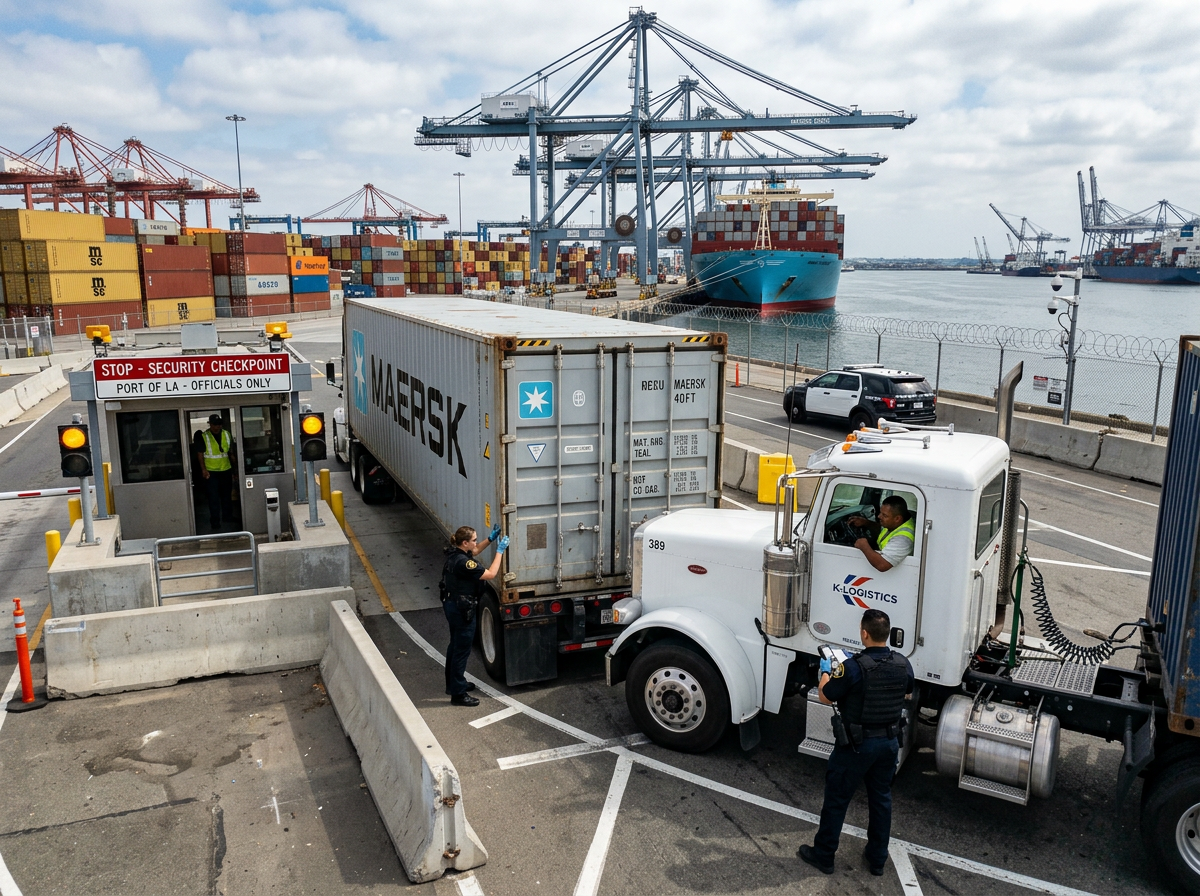
Traditional ground-based port security wasn’t built for the aerial agility of drones.
The Scale of a Port Stretches Traditional Security Measures
Port environments are elaborate mechanisms built to control movement through defined channels. People, vehicles, cargo, and vessels are all subject to layers of authorization, inspection, and control, with traditional security measures typically robust.
Yet these controls are largely organized around established access points. They weren’t built with aerial security in mind.
A drone can simply overfly sequential layers of physical security, bypass access controls, approach otherwise inaccessible assets, and leave without raising an alarm.
A port’s typically vast and decentralized footprint deepens this vulnerability. Drones can approach from adjacent public land, surrounding waterways, or vessels offshore, then move rapidly between separately controlled facilities.
As drone use grows in popularity, capability, and ease of access, the third dimension must be given greater prominence in port security planning. Detection must reflect the port’s dispersed layout, combining persistent coverage around critical areas with mobile and portable capabilities that can move with personnel and vehicles.

Vessels can become both drone targets and launch points, complicating the maritime CUAS picture.
Maritime Traffic Can Conceal Drone Launch Activity
While the management of vessels is core business for a port, the maritime environment also introduces the possibility of vessels being used as launch pads for drones, as well as targets.
Launching from a vessel extends a drone’s reach, opens up new approach angles, and helps disguise the activity among legitimate maritime traffic.
In September 2025, German authorities investigated allegations that the cargo ship Scanlark had launched a drone to photograph a German naval vessel. The ship’s operator disputed the allegation, but the case illustrates the difficulty of connecting a drone with its launch platform in a busy maritime environment.
This is where established maritime data can turn an isolated detection into actionable intelligence. If a radio frequency (RF) signature consistent with a drone control link is detected from an approaching vessel, the Automatic Identification System (AIS) can provide the vessel’s reported identity, position, and track. Correlating the two can identify a likely launch point and associate the drone activity with a specific vessel for further investigation.
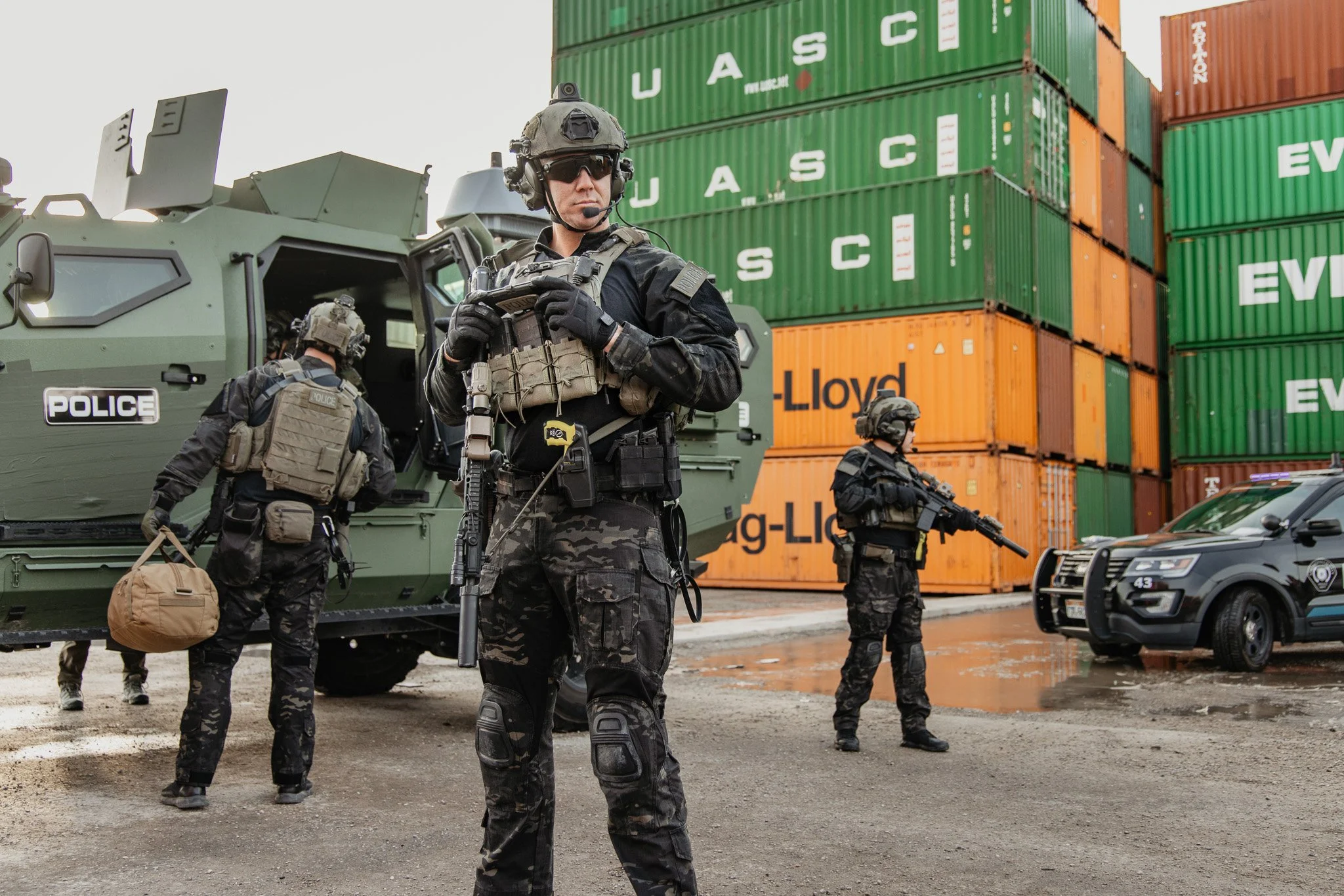
Building Counter-UAS Around the Complexity of Port Operations
Ports face a combined drone-threat profile that few other forms of critical infrastructure encounter.
No single sensor or deployment model can address that complexity. Distributed fixed RF sensors provide persistent coverage, while vehicle-mounted and portable systems extend detection across the port and respond to changing priorities.
The architecture should be layered, with passive RF providing early warning and signal characterization without disrupting operations. Radar and electro-optical systems can add detection and confirmation where required. This is particularly important where jamming and kinetic effects are restricted or unreasonable.
The outcome must be evidence and intelligence, not just more alerts. Port security teams need to characterize the drone, locate the controller where possible, connect activity with surrounding maritime and aviation traffic, and identify recurring behavior over time.
Ports have spent decades securing access by land and sea. But the threat landscape has expanded beyond those traditional boundaries. Effective Counter-UAS extends situational awareness into the airspace above, addressing a dimension of port security that conventional measures were never designed to protect.