

The End of Edges: How Drones Broke the Geometry of Defense
For most of history, security was built around direction.
Threats came from somewhere specific. Front lines, borders, coastlines, approaches. Defense planning assumed orientation: where an adversary would come from, how long it would take, and which systems would be brought to bear.
Drones changed that fundamentally.
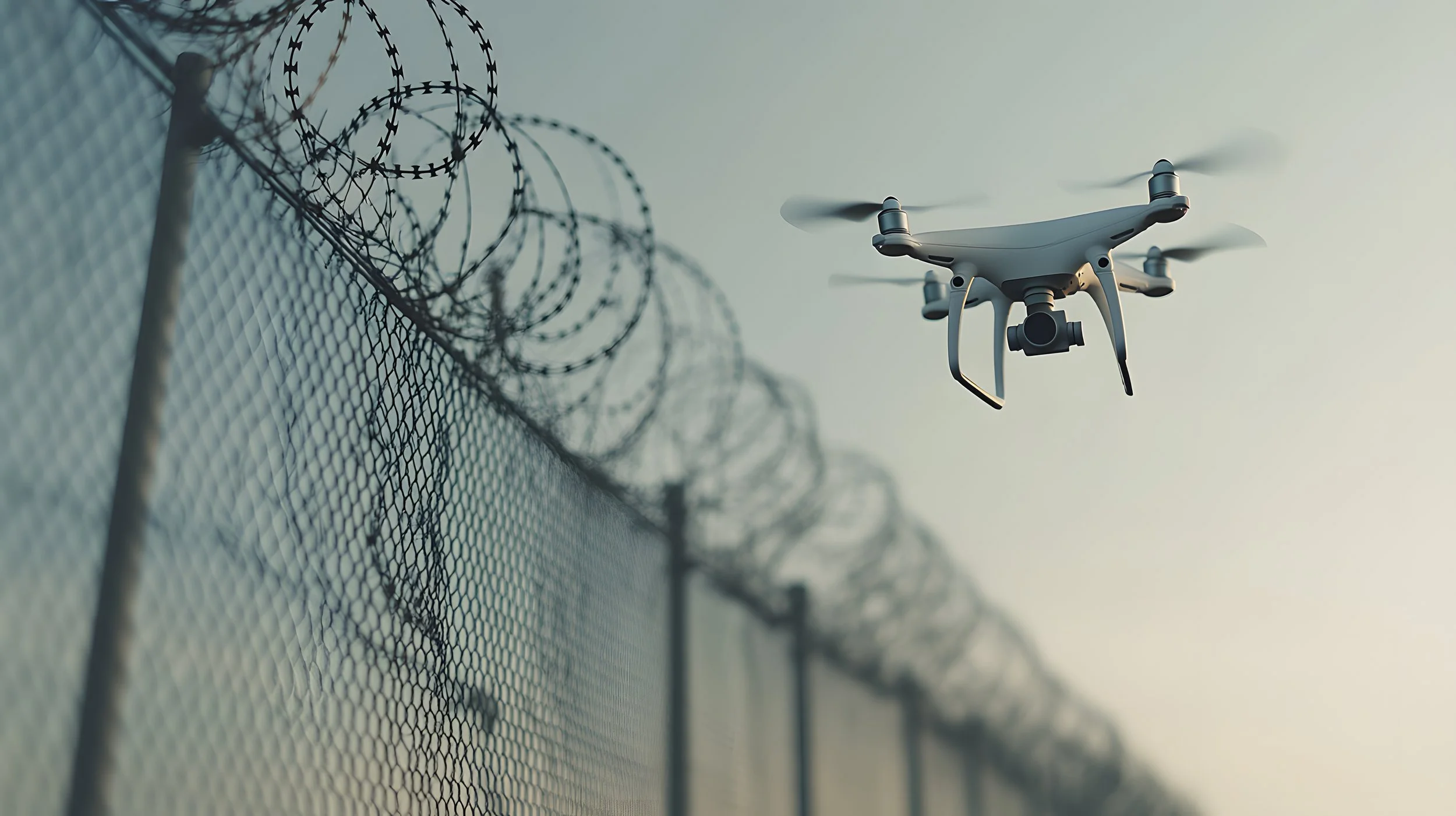
They did not simply introduce a new capability into conflict or security planning. They removed the underlying geometry that those models depended on. There is no longer a meaningful approach vector, no fixed direction, and no inherent advantage in holding a perimeter or a line. A low-cost system can be launched from a vehicle, a rooftop, a field, or a vessel. It can operate at low altitude, mask itself in clutter, blend into civilian airspace, and reappear without warning.
This is not a marginal evolution in threat, it’s a civilizational shift.
The Real Shift
Much of the public discussion around drones focuses on performance metrics: range, payload, autonomy. Those matter, but they are not the core issue. The deeper change is that drones collapse distance and time.
Traditional security systems rely on sequence: detect, track, respond. That sequence assumes there is space between the threat and the target, and time to act within it. Increasingly, neither assumption holds.
Small unmanned systems can operate below conventional radar coverage, above crowds, or inside shared civilian airspace where response options are constrained. In many cases, by the time an alert is raised, the opportunity to make a meaningful decision has already passed.
Defense models built primarily around reaction are being overtaken by drone incidents.
From Perimeters to Present Awareness
Cities, airports, prisons, power stations, military bases. All exist inside the same shared aerial environment. The sky over a stadium is the same sky over a highway, a hospital, or a residential neighborhood. That reality makes perimeter-based thinking increasingly irrelevant.
Security now depends less on holding a line and more on maintaining presence, persistent awareness of what is happening across an entire domain, not just at its boundaries.
This is why counter-drone has become a core requirement for public safety, critical infrastructure, and national security alike.
Detection Alone is Not the Answer
Early counter-drone efforts understandably focused on detection: find the drone, then respond. Detection remains essential, but on its own it is not enough.
As the airspace becomes more congested and threats more adaptive, isolated alerts without context generate noise rather than clarity. The challenge is no longer simply spotting an object, but understanding behavior: distinguishing benign activity from risk, recognizing patterns, and identifying escalation early.
The shift underway is from detecting drones to understanding airspace.
That requires systems designed to interpret information over time, fuse multiple inputs, and support decision-making under uncertainty. Awareness, not reaction speed alone, becomes the primary defensive advantage.
What Adapting Actually Looks Like
Adapting to this environment does not mean treating every drone as hostile, nor does it mean attempting to lock down airspace that is inherently shared. It means accepting that longstanding assumptions about direction, warning time, and certainty no longer apply.
Effective security must operate continuously rather than episodically. It must function in ambiguity, not perfect clarity, and it must coexist with civilian activity without disrupting it.
Organizations that make this shift will move from reacting to incidents and toward managing risk deliberately and intelligently. Those that do not will continue investing in defenses optimized for a world that has already moved on.
Drones did not simply introduce a new threat. They exposed a flaw in how security has traditionally been conceived.
In a world without edges, protection isn’t about where one stands, it’s about what is understood.
Click here to learn more about DroneShield’s RFAI and SensorFusionAI capabilities.