

Why CUAS Infrastructure Protection Is More Important Than Ever
Due to a significant and ever-increasing rise in the proliferation, advancement, and usage of drone technology, it has become more important than ever to set measures in place that protect critical infrastructure from incursions and espionage. With widespread growth and adoption of hyperscale data centers, the drone threat is felt readily in the information control sector. These massive data centers support large-scale automation, analytics, storage, processing, and standard vital computing tasks, making them prime targets for attack.
Data Center Drone Threats
Despite what many might think with global drone warfare dominating daily news broadcasts, true security against this threat is often overlooked in areas that need it the most. As with all critical infrastructure, the prevailing common threat is no longer primarily digital. Apart from credible risks of hacking and data vulnerabilities, physical aerial threats are now all too common. This includes not just compromised data center physical security but also sensitive data theft via drone surveillance. There have been several such instances of drones spying on sensitive areas in Europe in 2025, as seen at a Belgian airbase and German critical infrastructure.
The immediate danger with drones is that they can be remotely piloted or programmed to perform pre-defined actions, making them incredibly agile and adaptive threats to all aspects of critical infrastructure security. Traditional measures cannot compete with small uncrewed aerial systems (UAS), slowing response times due to a lack of situational awareness and mitigation capability.
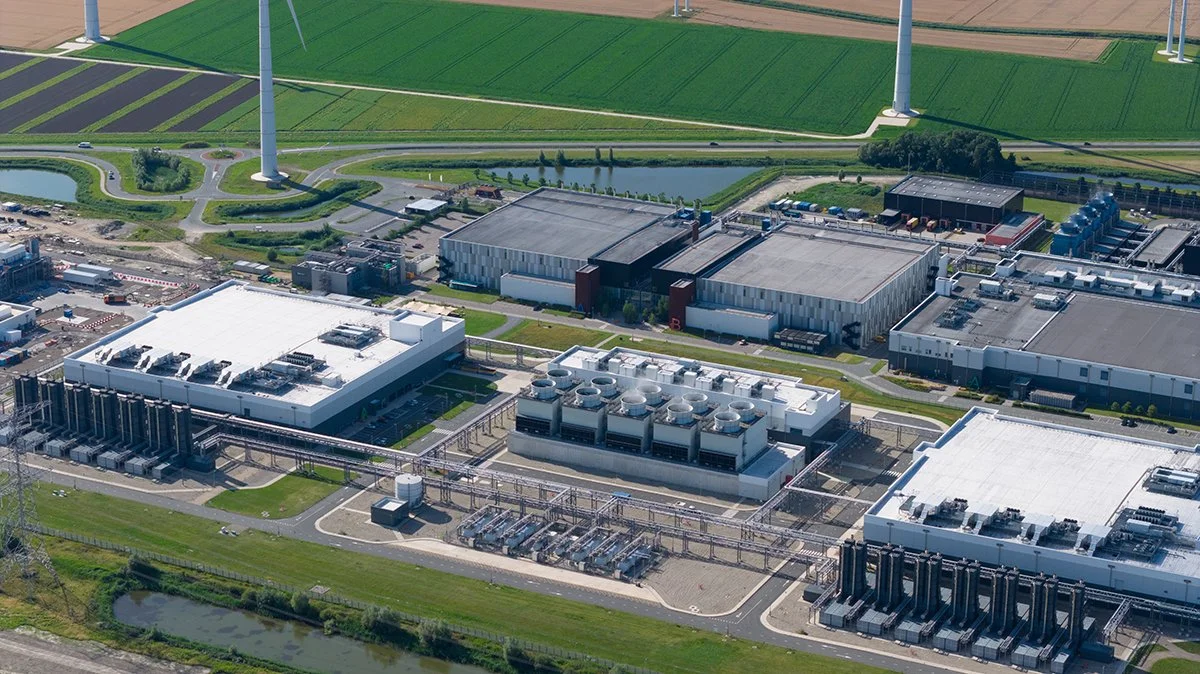
Pictured: Aerial view of data center
The Cost of Complacency
So, what’s the solution? As with all counter-drone technology, the key is in initiating and adopting an array of solutions that promote and maintain deterrence as the first layer of defense. This is achieved by combining a range of interconnected counter-UAS technologies for data centers that work together to proactively detect, track, assess, and potentially neutralize drone. It is important to note that drone disruption permissions are dictated by local laws and regulations. Those that underplay the importance of comprehensive CUAS infrastructure protection are actively putting their businesses and premises at risk. After all, the consequences of complacency are plentiful:
Compromised physical security
Intelligence and data theft
Financial cost of disrupted operations
Electronic warfare enacted via drone
Even as early as 2010, the Ponemon Institute conducted a survey in the United States to measure certain variables and consequences of data center outages. It showed that companies reported losses that ranged from ~$1,000 USD to over $1,000,000 USD for just one hour of unplanned outages. That number was again calculated to show an average of $9,000 USD a minute in a 2016 study. As recently as 2024, Uptime Intelligence reported that on average, small-to-medium size data centers experienced losses ranging from $100,000 USD to $1,000,000 USD a year due to unplanned, non-drone-related outages. These studies show just how costly outages are, and just how much the drone threat can, and often does, contribute – and that’s only the financial impact.
In terms of privacy, a drone-led breach can put the digital safety of millions at risk. Personal data leaks are already prevalent, and they do not need another avenue of approach. When it comes to physical security, staff working at data centers can be followed or even physically targeted as part of an incursion. And all of this can be achieved with just a single small drone, let alone a swarm.
Counter-UAS Technology for Data Centers
The first and most important step here is detection. DroneShield offers the SentryCiv, a fixed radio frequency (RF) drone detection system purpose-built to safeguard critical infrastructure and provide operators with detailed early warnings about a drone presence. Utilizing the proprietary Radio Frequency Artificial Intelligence (RFAI) detection engine, it can scan for commonly used and emerging drone RF signatures, as well as decode mandated drone beacons. To boost on-the-ground security awareness, the RfPatrol Mk2 can be deployed with similar results.
To create a comprehensive security perimeter, RF sensors can be combined with radars and optical camera sensors. Controlled and monitored by a Command-and-Control platform such as DroneSentry-C2, each system’s strength can be leveraged to its fullest extent via the proprietary SensorFusionAI (SFAI). SFAI fuses all sensor inputs to create a clear picture with real-time alerts, enabling scalable perimeter coverage with non-invasive solutions.
The Way Forward
Maintaining and strengthening the security of data centers and effectively combatting this evolving problem cannot occur until the true severity of the threat is acknowledged, allowing for legislation and budgets to catch up with reality. Ultimately, drones are just an additional threat vector in a sector that is vulnerable to attacks from all sides. That’s why counter-drone technology adoption isn’t a question of if, it’s a question of when and how comprehensive it needs to be. And to ensure true security, CUAS technology adoption must begin at the data center planning stage. Without these measures in place at the outset, data centers would essentially be allowing malicious actors unimpeded access to sensitive data and leave themselves unprepared for a potential incursion. Securing the world’s digital infrastructure starts with controlling its airspace.